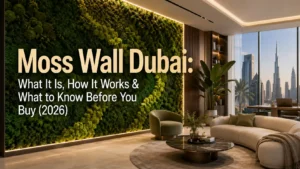
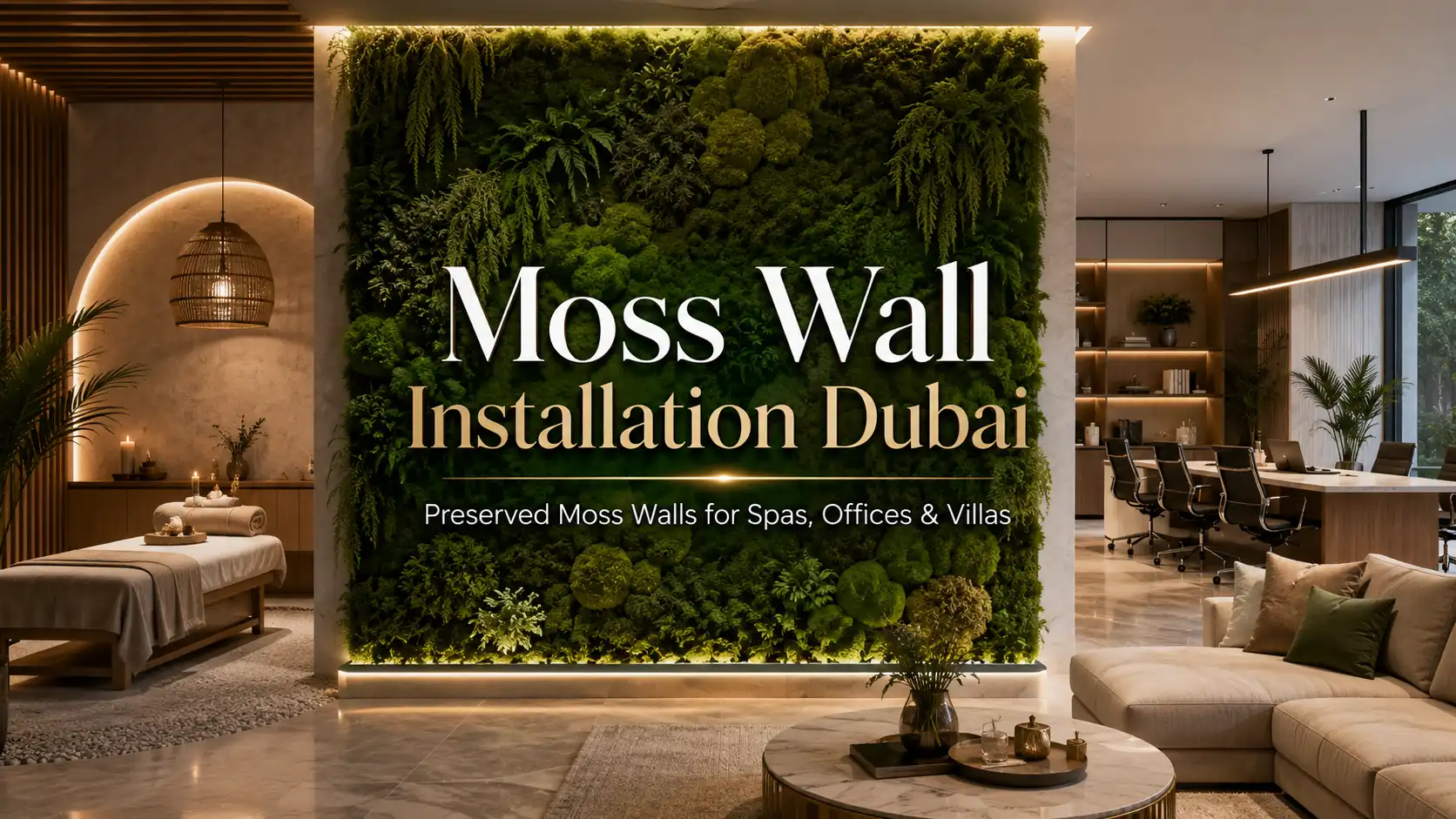
A preserved moss wall creates the visual richness and natural texture of a planted interior feature — without a single millilitre of water, without any light requirements beyond ambient indoor lighting, and without any ongoing maintenance beyond an occasional light dusting. For Dubai’s heavily air-conditioned interior environments, preserved moss walls are the most practical way to introduce genuine natural material into an indoor space that cannot support living plants.
Flowers Yard Landscaping designs and installs custom preserved moss walls across Dubai — for corporate office receptions, hotel lobbies, spa and wellness spaces, restaurant feature walls, gym and fitness studios, and villa interiors. Every installation is designed specifically for the space — no off-the-shelf panel systems — and installed by our directly employed team.
Free Consultation
Book a Free Site Visit for Your Space
We visit your space, assess the wall, discuss your design brief, and provide a custom quotation.
What Is a Preserved Moss Wall?
Preserved moss is natural moss that has been harvested at peak condition, then processed through a preservation technique — most commonly a glycerin- or paraffin-based bath that replaces the moisture content of the moss with a stabilising solution. The result is moss that retains its original colour, texture, density, and tactile softness indefinitely, without any biological activity. It is no longer alive — but it looks and feels precisely as it did when it was.
This preservation is what makes moss walls practical for Dubai interiors. A living moss wall requires specific humidity levels, indirect natural light, a water supply, and regular attention to maintain its health. A preserved moss wall requires none of these. It does not need a drainage system, it does not need a grow light, it does not need an irrigation connection, and it does not need horticultural expertise to maintain. It simply exists — providing natural texture, visual warmth, and a connection to nature that no synthetic material can replicate — for years.
The moss we use is sustainably harvested and certified from Scandinavian and Northern European sources where wild moss grows in abundance. Responsible harvesting — taking selectively from large populations rather than stripping areas — is standard practice among quality European moss suppliers, and the certification of sustainable sourcing is something we confirm with every supply chain.
Types of Moss Used in Preserved Moss Walls
The character of a moss wall is determined by the species of moss used, how they are combined, and the depth and layering of the composition. We work with three primary moss types, each with distinct visual and tactile properties.
Reindeer moss — the most versatile
Reindeer moss (Cladonia rangiferina) is technically a lichen rather than a true moss — but it is the material most widely used in preserved wall installations and the one that defines the category visually. It has a highly branched, airy, coral-like structure that creates a three-dimensional textured surface with visible depth. When installed in a dense composition, it creates a surface that draws the eye and invites touch.
Reindeer moss is available in a wide range of colours — from natural green tones through forest green, sage, olive, lime, and into dyed palettes including grey, black, white, deep blue, and custom corporate colours. This colour range makes it the primary choice for branded and logo installations where specific brand colours need to be matched.
In a Dubai interior context, reindeer moss is the most commonly specified type because its three-dimensional structure creates shadow and depth that photographs well under both natural and artificial light — important in spaces designed to be shared on social media, including restaurants, hotel lobbies, and spa interiors.
Flat moss — organic and grounded
Flat moss refers to several species of true mosses (Hypnum, Thuidium, and similar) that grow in dense, low, carpet-like forms. Preserved flat moss creates a smooth, continuous surface that looks similar to a manicured lawn turned vertical — dense, lush, and uniformly textured. It has a softer, more grounded visual quality than reindeer moss and tends toward natural green tones without the dramatic branching structure.
Flat moss is frequently used as a background base in mixed compositions where reindeer moss or other elements are applied on top, creating layered depth. It is also used alone for wall panels that aim for a refined, understated texture rather than a bold statement — popular in spa and wellness environments where calm and serenity are the design priority.
Cushion moss — sculptural and dimensional
Cushion moss grows in rounded, dome-shaped colonies that create a strongly three-dimensional, almost sculptural surface when installed in quantity. Individual cushions are typically 5 to 15cm in diameter and 5 to 10cm deep, giving a moss wall made from cushion moss a pronounced relief that creates strong shadow lines under directional lighting.
Cushion moss tends to be used as an accent element within larger mixed compositions rather than as the sole material across a full wall — its bold texture can overwhelm a space if used without the counterpoint of flatter elements. In villa and hospitality interiors, cushion moss is often combined with flat and reindeer moss to create a composition that has both depth and variety.
Mixed compositions — the standard for bespoke work
Most of the moss wall installations we design for Dubai clients are mixed compositions combining two or three moss types within a single wall. The proportion and arrangement of each type creates the visual character of the finished work — a spa wall might use predominantly flat moss with cushion moss accents in a calm, ordered composition; a restaurant feature wall might use reindeer moss in multiple green tones with flat moss backing for a rich, layered, immersive effect; a corporate reception might incorporate reindeer moss in brand colours to create a logo or abstract graphic element within the green field.
Where We Install Preserved Moss Walls in Dubai
Spa and wellness spaces
Moss walls are one of the most requested features in Dubai spa and wellness interiors. The material’s inherent association with nature, forest environments, and sensory calm makes it a natural fit for treatment rooms, relaxation lounges, hammam changing areas, and wellness corridors. The acoustic properties of moss — its soft, irregular surface absorbs sound rather than reflecting it — contribute genuinely to the quieter atmosphere a spa environment requires.
For spa installations, we most commonly use flat and cushion moss compositions in natural green tones, often combined with sections of timber slat panels, stone tile, or natural render to create a multi-material sensory wall. Lighting for spa moss walls is typically warm and low — LED strips positioned to graze the surface and emphasise the texture without harsh shadows.
Corporate offices and reception areas
Dubai’s corporate interior design market has adopted preserved moss walls enthusiastically — and with good commercial justification. Research published by the International WELL Building Institute links biophilic design elements in office environments to measurable improvements in occupant wellbeing, reported focus, and perceived environmental quality.
Companies pursuing WELL certification or simply wanting to demonstrate environmental and wellness credentials to staff and visitors are active buyers of moss wall installations.
The most common office moss wall applications we deliver in Dubai:
- Reception feature wall — the wall behind a reception desk is the most impactful single wall in an office. A full-height preserved moss wall creates an immediate, strong first impression for clients and visitors.
- Meeting room biophilic wall — a moss wall on one face of a meeting room reduces acoustic reverberation, creates a calming focal point for participants, and differentiates the space from standard corporate meeting room aesthetics.
- Breakout and collaboration zone dividers — moss panels used as room dividers or zone markers in open-plan offices introduce natural texture and acoustic absorption without blocking sight lines.
- Branded and logo moss walls — reindeer moss in brand colours, used to create a corporate logo or branded graphic element within the moss composition. Very popular in Dubai’s tech, finance, and hospitality sector offices.
Hotels and hospitality venues
Hotels in Dubai use preserved moss walls across multiple touchpoints — from grand lobby installations to corridor feature walls, restaurant interior features, pool-adjacent relaxation zones, and guest floor corridor accents. The zero-maintenance property of preserved moss is particularly valuable in hospitality environments where operational complexity must be minimised, and any failing feature reflects immediately on the guest experience.
Hotel moss wall installations tend to be larger in scale and higher in specification than residential or even corporate projects. A full-height lobby moss wall in a 5-star Dubai hotel may cover 50 to 200 sqm of surface — a scope that requires careful planning of the installation sequence, the substrate preparation, and the overall visual design to ensure consistency across the full surface.
Restaurants and food and beverage venues
Restaurant moss walls in Dubai serve both a design and a commercial function. Visually, they create a distinctive, natural atmosphere that differentiates the venue from competitors. Commercially, a well-designed moss wall becomes a photography backdrop — it appears in hundreds of guest social media posts and in press coverage, providing organic visibility that exceeds the installation cost many times over.
We work with restaurant designers, F&B operators, and direct clients on moss wall installations for new restaurant openings, refurbishments, and pop-up activations. We can work within tight fit-out timelines and after-hours installation schedules to avoid disrupting operations.
Villas and residential interiors
Preserved moss walls in Dubai villas are installed in living rooms, home offices, master bedrooms, entrance hallways, and media rooms — wherever a feature wall is desired that introduces natural material without the maintenance of living plants. In villa interiors, moss walls are often combined with other natural materials — timber frames and dividers, stone panels, or mixed with dried botanicals and sculptural elements — to create a feature that is unique to the property rather than a standard product installation.
Scale in villa installations tends to be more modest than hospitality projects — a single feature wall of 4 to 15 sqm rather than full room coverage — and the design is tailored to complement the existing interior material palette and colour scheme.
Gyms, fitness studios, and yoga spaces
Fitness environments in Dubai are increasingly designed with wellbeing credentials as a differentiator. A preserved moss wall in a gym or yoga studio introduces the visual qualities of a nature-connected environment without any of the operational complexity of plants in a high-humidity, high-traffic exercise space. The acoustic properties of moss are particularly valuable in yoga studios and group fitness rooms where reverberation affects the quality of instruction and the overall atmosphere.
The Acoustic Properties of Moss Walls — What the Science Actually Says
Moss walls are marketed by almost every supplier in Dubai as providing acoustic benefits. This claim is true — but the degree and type of benefit is often overstated. Here is the accurate picture.
Preserved moss, like all soft, porous, and irregular-surface materials, absorbs incident sound energy rather than reflecting it. Smooth, hard surfaces — painted concrete, glass, polished stone — reflect sound back into a space, increasing reverberation time and creating the ‘hard’ acoustic quality that makes rooms feel loud and echoey. Soft, textured surfaces absorb a portion of incident sound energy, reducing reverberation.
The acoustic absorption coefficient (NRC — Noise Reduction Coefficient) of preserved moss panels varies depending on the moss species, the panel depth, and the backing material. Typical NRC values for preserved moss panels range from 0.3 to 0.6 at mid-range frequencies — comparable to fabric panels and soft furnishings, and meaningfully better than hard wall finishes (NRC approximately 0.05).
What this means practically in a Dubai office or restaurant:
- A moss wall meaningfully reduces reverberation time in a room — the time it takes for a sound to decay after the source stops. This is the ‘echo’ quality that makes spaces feel harsh.
- It is not equivalent to a specialist acoustic panel system — dedicated acoustic panels with mineral wool or acoustic foam backing achieve NRC values of 0.7 to 1.0 and are more efficient per square metre of wall coverage
- The acoustic benefit is real and noticeable, particularly in hard-surfaced Dubai interiors where all wall, floor, and ceiling finishes are reflective materials
- For spaces where acoustic performance is a primary design requirement — recording studios, confidential meeting rooms, audiologically sensitive environments — moss walls alone are not sufficient and should be combined with purpose-designed acoustic treatment
For most commercial and residential applications in Dubai — offices, restaurants, spas, hotel lobbies, villa living rooms — the acoustic contribution of a moss wall is a genuine benefit that complements the visual and biophilic value of the installation.
Preserved Moss Walls in Dubai’s Climate — What Actually Affects Longevity
Dubai’s indoor environment is heavily air-conditioned for seven to eight months of the year. Air conditioning reduces indoor relative humidity — often to 30 to 45% RH in well-conditioned commercial and residential spaces. This is the primary environmental factor that affects preserved moss wall performance in Dubai, and it is one that most suppliers in the market do not address honestly.
Humidity and preservation medium interaction
Preserved moss walls processed with glycerin-based preservatives are moderately hygroscopic — they respond slightly to ambient humidity levels. In very dry environments (below 30% RH sustained over long periods), glycerin-preserved moss can gradually lose some of its suppleness and become slightly more brittle than when first installed. This does not affect appearance significantly, but it does make the moss more vulnerable to physical damage from impact or compression.
In Dubai’s typical air-conditioned interior at 30 to 50% RH, quality glycerin-preserved moss performs well. Paraffin-preserved moss is less humidity-sensitive and performs consistently across a wider humidity range — it is the specification we recommend for installations directly below air conditioning outlets or in spaces where the AC system is particularly aggressive.
Direct sunlight — the most damaging factor
UV radiation causes colour fading in preserved moss, just as it causes fading in any organic material. Preserved moss installed in locations receiving direct sunlight — near unshaded windows, under skylights, or in outdoor-adjacent positions with significant UV exposure — will show colour degradation within months.
Preserved moss walls must be installed in positions that receive ambient indoor light but are not in direct sun paths. This is not a limitation in most Dubai interior applications — the vast majority of the locations where moss walls are installed (interior reception walls, spa treatment rooms, meeting rooms, restaurant feature walls) do not receive direct sunlight. We assess the lighting conditions of every installation position during the site visit and advise on suitability before any design is finalised.
Temperature stability
Preserved moss walls perform best in temperature-stable environments. In Dubai’s air-conditioned interiors, temperature stability is generally good. Areas near external doors that cycle between very hot outside air and cooled indoor air — such as entrance lobbies and hotel arrival areas — present more challenging conditions. For these locations, we recommend slightly heavier-specification preservative systems and placement away from the immediate door zone where temperature cycling is most pronounced.
Physical contact — the most common cause of damage
The most frequent cause of moss wall damage in Dubai installations is physical contact — guests touching restaurant walls, children pulling at villa installations, maintenance staff leaning equipment against office feature walls. Preserved moss, while durable for a natural material, is not impact-resistant in the way that a painted surface or stone tile is.
We address this through design — positioning moss walls at a height or in a configuration that minimises casual contact, installing protective frames or ledge details that prevent leaning, and using protective glass or acrylic panels over high-contact zones in hospitality environments. We also carry out patch repairs as needed during any maintenance visit.
Moss Wall Design Options — What We Can Create
Preserved moss walls are one of the most versatile interior design materials available. The design possibilities extend well beyond covering a wall in a single moss type.
Full wall coverage in single or mixed moss
The most common design — a wall surface covered from edge to edge in a continuous moss composition. Single-moss installations (all reindeer or all flat moss) create a clean, uniform texture. Mixed compositions introduce visual interest through the contrast of different moss textures and tones within the same field. Colour gradients — where the moss composition shifts from one green tone to another across the wall surface — create a sophisticated, designed quality that reads as intentional art rather than simple coverage.
Framed panels and modular installations
Individual moss panels in timber, aluminium, or powder-coated steel frames, installed as a gallery arrangement on a wall surface rather than as continuous coverage. This approach suits spaces where the host wall material is a design feature in its own right — exposed concrete, natural stone, or feature tiles — and where full coverage would obscure that material. Framed panels can be arranged symmetrically or in a curated composition and can be removed and repositioned as needed.
Mixed material compositions
Moss combined with other natural and architectural materials within a single wall feature. Common combinations in Dubai installations:
- Moss and timber slat panels — natural timber vertical or horizontal slats framing zones of moss, creating a warmth and materiality that suits contemporary villa and hotel interiors
- Moss and stone or concrete panels — the contrast of the soft organic texture of moss against the hard mineral quality of stone or polished concrete creates a compelling material dialogue
- Moss and dried botanicals — preserved branches, dried flowers, or other dried botanical elements integrated into the moss field for a richer, more complex natural composition
- Moss, mirror, and brass — a combination popular in Dubai restaurant and hotel bar installations where the moss provides organic warmth and the reflective materials add luxury and light amplification
Corporate logos and branded elements
Reindeer moss in brand-specific colours used to create a company logo, wordmark, or graphic element within the moss field. This is the most requested corporate moss wall application in Dubai in 2026 — office reception walls that combine a branded element with a biophilic feature create a powerful first impression for visitors while supporting the company’s environmental and wellness positioning.
Logo moss walls require precise colour matching of the reindeer moss to the brand colour palette. We work from Pantone or RAL references and provide colour samples for approval before committing the full installation. The design is developed as a scale drawing for client approval before moss is cut and applied.
Three-dimensional relief and sculptural compositions
Moss compositions that extend beyond flat coverage into the third dimension — using the natural depth of cushion moss, layering reindeer moss at varying heights from the backing surface, or incorporating sculpted timber or steel substrates that the moss is applied over to create an undulating, relief surface.
These are bespoke art installations as much as surface treatments, and they are developed as individual commissions with detailed design drawings before fabrication begins.
The Installation Process
Site visit and design consultation
We visit the space to assess the wall substrate, its condition, the ambient lighting (both natural and artificial), the humidity and temperature environment, and any access constraints for installation. We discuss your design brief — the aesthetic direction, the intended atmosphere, any specific moss types or colour tones you are drawn to, and any branded or graphic elements to be incorporated.
For corporate and hospitality clients, we often work alongside the interior designer or project architect — taking their design intent and translating it into a practical moss wall specification that achieves the visual effect within the budget and timeline constraints of the project.
Design development and approval
Based on the site visit, we develop a detailed design proposal showing the moss composition, colour palette, any mixed materials, framing details, and installation method. For larger installations and branded elements, we prepare scale drawings or digital renderings for client approval before any materials are ordered or work begins.
Substrate preparation
The wall substrate must be sound, clean, and dry before moss installation begins. For plasterboard and painted walls, we confirm surface integrity and apply a bonding primer where needed. For concrete and masonry walls, we check for any moisture issues that would affect adhesive performance. For glass and other non-porous substrates, we use specialist adhesive systems appropriate for the material.
The backing system used for the moss is typically an MDF or PVC panel system that is prepared off-site and transported to the installation location. This approach minimises on-site installation time and allows quality control of the moss application in our workshop before the finished panels are installed on the wall.
Moss preparation and application
Moss panels are prepared in our workshop — sections of the different moss types are carefully placed and bonded to the backing panels according to the approved design. Reindeer moss sections are arranged to create the desired density and colour distribution. Flat moss is applied continuously for background zones. Cushion moss is positioned individually. Logo elements are cut precisely and positioned to achieve clean edges and accurate colour boundaries.
Prepared panels are quality-checked before leaving the workshop and transported to site in protective packaging.
Installation and finishing
Panels are installed on the prepared wall using a combination of mechanical fixing and adhesive appropriate for the substrate and wall loading. Panel joints are blended with additional moss applied on-site to eliminate visible seams. Any framing, lighting, or mixed material elements are installed and connected. The completed wall is inspected, and any final adjustments to the moss composition are made before the installation is signed off.
Installation time for a standard office or villa moss feature wall (5 to 20 sqm) is typically 1 to 2 days on site. Larger commercial installations are planned on a project schedule agreed with the client.
Maintenance — The Honest Answer
‘Zero maintenance’ is how preserved moss walls are sold by most suppliers in Dubai. The honest answer is more nuanced — ‘minimal maintenance’ is more accurate than ‘zero maintenance’.
A preserved moss wall in a correctly specified interior environment requires:
- Dusting approximately every 3 to 6 months — dust settles on the moss surface and in the recesses of the branching structure over time. Removal with a soft brush, compressed air at low pressure, or a gentle vacuum at low suction with a soft brush attachment keeps the moss looking fresh. Do not use water or liquid cleaning agents — these can affect the preservation medium.
- Inspection of any mixed material elements — timber framing, metal components, and other materials in a mixed moss installation benefit from periodic checking for any movement, moisture, or finish degradation.
- Patch repair for any areas of physical damage — moss that has been pulled out, compressed, or discoloured through contact can be repaired with additional moss material. We carry out patch repairs as a service for all installations.
What preserved moss walls do NOT require:
- No watering — ever. The preservation process has replaced all biological functions. Adding water does not ‘revive’ moss and can damage the preservation medium.
- No lighting requirements — preserved moss is not a living organism and does not perform photosynthesis. It does not need grow lights, UV lamps, or any minimum light level.
- No fertilising or feeding
- No pruning or trimming
- No irrigation system, drainage, or plumbing connection of any kind
| Important for Dubai installations: do not position preserved moss walls directly beneath air conditioning outlets where cold, dry air is directed continuously onto the moss surface. Sustained cold airflow accelerates moisture loss from the preservation medium faster than ambient conditions allow. Position AC outlets to direct airflow away from or parallel to the moss wall surface rather than directly onto it. |
Moss Wall vs Living Green Wall vs Artificial Green Wall — Which Is Right for You?
Dubai clients frequently ask us to help them choose between these three types of wall greenery. Each has a different operating principle, different practical requirements, and a different design quality. The right choice depends entirely on your space, your goals, and your maintenance capacity.
Preserved moss wall
Best when: you want a genuinely natural material with zero operational complexity. No water, no light requirements, no infrastructure. The design quality is organic and unique — every moss wall looks different because natural moss has natural variation. The palette is predominantly green tones with some colour range through preserved dyes. Works in spaces with no natural light and no water access.
Living plant wall
Best when: you want the full sensory and air quality benefits of living plants — real greenery, changing and growing over time, genuine air filtration, and the vitality of something alive. Requires an automatic irrigation system, access to water supply, adequate light (natural or artificial grow lighting), and a regular maintenance programme. More demanding and more expensive to operate than moss, but delivers an impact that nothing else can match. For our living plant wall service, see our green wall installation page.
Artificial green wall
Best when: you want the appearance of a green wall at the lowest cost and with the simplest installation. Quality artificial panels look convincingly natural at a distance and in photography. Suitable for high-contact areas and outdoor use with UV-rated panels. Less tactilely convincing than preserved moss at close range, and lacks the acoustic properties of real moss. For our artificial green wall service, see our green wall installation page.
Need Honest Advice?
Not Sure Which Option Suits Your Space?
Contact us and we will assess your location and requirements honestly — recommending the solution that best fits your space, budget, and goals.
Frequently Asked Questions
1- How long does a preserved moss wall last in Dubai?
A quality preserved moss wall in a correctly specified Dubai interior environment typically maintains its appearance for 8 to 12 years. The primary factors affecting longevity are UV exposure (direct sun accelerates fading significantly), the humidity level maintained by the AC system, the quality of the preservation process, and the degree of physical contact the installation receives. We specify the preservation method and panel design to suit the specific conditions of each installation after the site visit.
2- How much does a moss wall cost in Dubai?
Moss wall cost in Dubai depends on the wall size, the moss types specified, the complexity of the design, any mixed material elements, and the installation logistics. A small villa feature wall panel is a different scope from a full hotel lobby installation across 100 sqm with branded graphic elements. We do not publish fixed price lists — every installation is assessed individually and quoted after a free site visit and design consultation. Contact us to arrange a visit: +971 55 678 6066.
3- Do moss walls work in Dubai’s dry air conditioning environment?
Yes, with correct specification. Quality glycerin- or paraffin-preserved moss performs well in the 30 to 55% relative humidity range typical of Dubai’s air-conditioned interiors. We specify the appropriate preservation method for each installation based on the humidity conditions of the space. The main precautions are avoiding positioning directly under aggressive AC outlets and keeping the installation out of direct sun paths — both of which we assess during the site visit.
4- Can moss walls be used outdoors in Dubai?
Preserved moss walls are indoor installations only. Outdoor UAE conditions — direct sun, heat above 40°C, occasional heavy rain, and sand exposure — are incompatible with the longevity of the preservation medium. Outdoor environments also expose the moss to humidity extremes far beyond what the material is designed for, causing degradation within weeks rather than years. For covered outdoor areas with controlled conditions — enclosed courtyards with climate control, indoor-outdoor lobby spaces — we assess suitability on a case-by-case basis after inspecting the specific environmental conditions.
5- How long does installation take?
A standard residential feature wall of 5 to 15 sqm takes 1 to 2 days on site. A medium commercial installation of 20 to 50 sqm typically takes 2 to 4 days. Large hospitality installations are planned on individual project schedules. All moss panel preparation is completed in our workshop before site work begins — this minimises on-site time and allows thorough quality control before installation.
6- Can you repair or patch a damaged moss wall?
Yes. Patch repairs for areas of physical damage, colour loss, or moss that has been accidentally removed are straightforward with preserved moss because additional material can be bonded directly into the existing installation. We carry out patch repairs for all our installations as a service. For installations not done by Flowers Yard, we assess the existing work and advise on the best repair approach before committing to any repair scope.
7- Can I install a moss wall myself?
Small framed moss panels purchased as a finished product can be hung on a wall without specialist installation skills. A bespoke custom moss wall designed and installed across a full wall surface requires professional installation to achieve a seamless finish with no visible panel joints, correct substrate preparation, and precise execution of any design elements like logos or colour gradients. Poor DIY installation is the most common reason for premature moss wall damage — compressed or poorly adhered moss does not recover.
8- Do you work with interior designers on moss wall projects?
Yes — and working with the interior designer or project architect early in the design process creates better outcomes for everyone. We contribute technical knowledge of what is achievable — substrate requirements, the realistic colour palette of preserved moss, acoustic performance data, installation method constraints — while the designer leads the aesthetic direction. We have worked with interior design practices across Dubai on villa, hospitality, and corporate projects and are comfortable working to design intent drawings and project timelines.
Get a Free Moss Wall Consultation in Dubai
Flowers Yard Landscaping designs and installs preserved moss walls across Dubai for spas, offices, hotels, restaurants, gyms, and villas. Every installation is bespoke — designed for your specific space, specified for the environmental conditions, and installed by our directly employed team to a standard that holds up over years, not months.
The consultation is free. We visit your space, assess the wall and its environment, discuss your design brief, and provide a detailed custom quotation and design proposal — with no obligation to proceed.
Moss Wall Installation Dubai
Ready to Create a Custom Moss Wall?
WhatsApp us a photo of the wall and a brief description of the space. We will respond within a few hours.
We serve all Dubai communities and work with designers, operators, developers, and direct clients across the UAE.