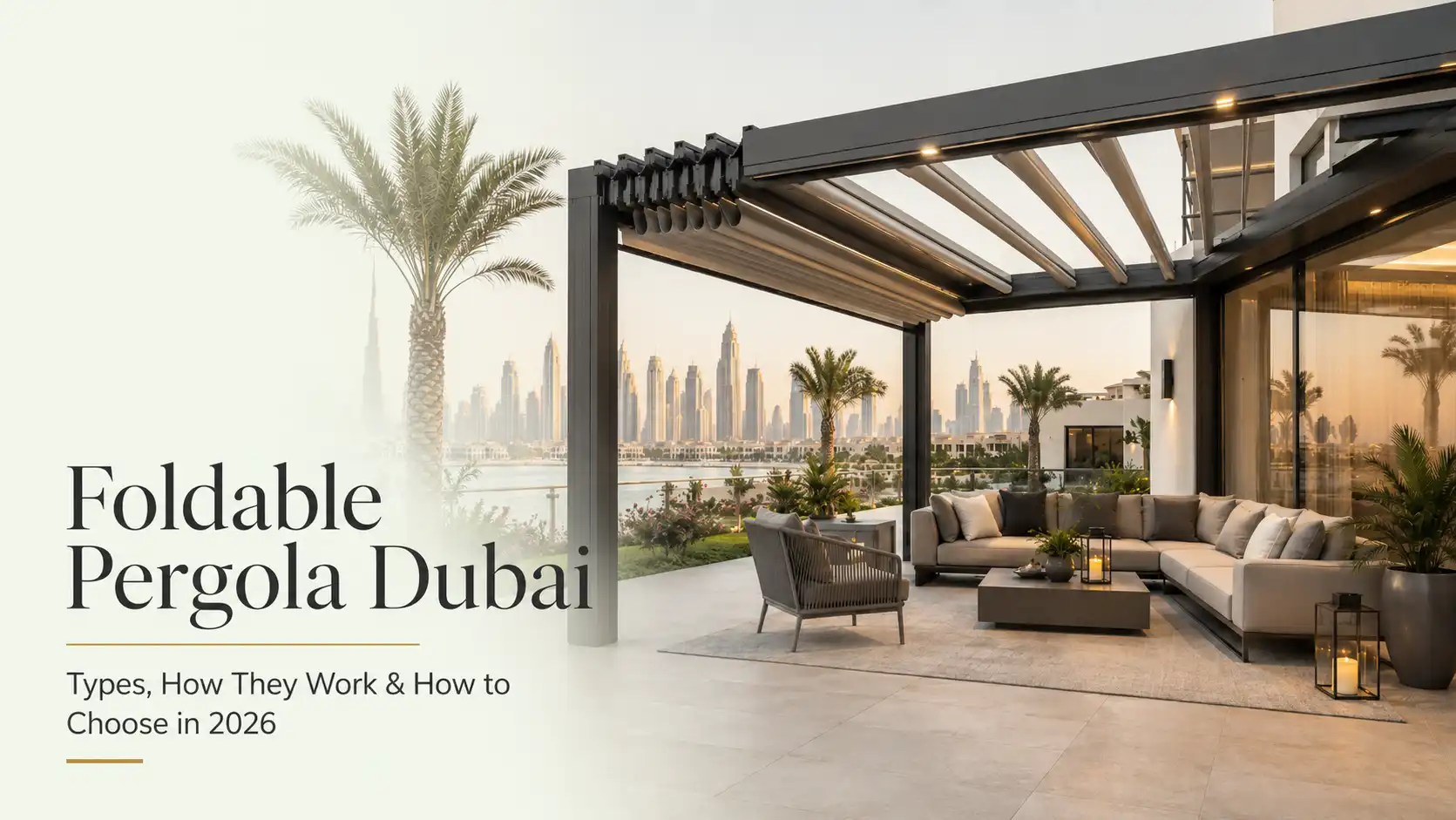
A fixed pergola offers shade in one position, in one weather condition, at one time of day. In Dubai, that is not enough. The sun angle changes dramatically between December and June. An afternoon that is pleasant in February is brutal in May. An outdoor space that needs to function as a dining area one evening and a sun-drenched pool terrace the next morning cannot rely on a structure with no flexibility.
This is why foldable, retractable, and louvered pergola systems have become the most requested outdoor shade investment for Dubai villa owners, hotel designers, and restaurant operators in 2026. They give you the one thing a fixed structure cannot: control. Open when you want open sky. Closed when you need rain protection or shade. Every position in between when you want filtered light and airflow.
This guide explains in real detail how each foldable pergola system type works, what the engineering differences are between quality systems and cheap ones, which use cases each system suits, and how to make the right choice for your specific outdoor space. It is written by Flowers Yard Landscaping, based on installing these systems across Dubai villa communities, hotels, and restaurants throughout 2025 and 2026.
Fixed vs Foldable — Why Flexibility Matters in Dubai’s Specific Climate
Dubai’s climate is not a single condition to design around — it is a range of conditions that changes significantly through the year and within each day. Understanding this is the starting point for specifying any outdoor shade structure.
November to March
18°C – 28°C
The weather is exceptional, with low humidity, clear skies, and long comfortable evenings. In these months, you want your outdoor space to feel as open and connected to the sky as possible.
A structure that blocks this — a solid roof or a fixed closed canopy — actively reduces the quality of the outdoor experience during the best months of the year.
April to May & September to October
Low to Mid 40s
Temperatures climb with increasing humidity. Direct sun on a west- or south-facing terrace makes the space uncomfortable from early afternoon.
In these months, you need partial shade control — the ability to filter afternoon sun while maintaining airflow and light. A structure that is either fully open or fully closed cannot do this.
June to August
Peak Summer
Peak summer conditions make outdoor use impractical between roughly 10 am and 7 pm without active cooling.
Dubai evenings in summer — from 8 pm onward as temperatures drop below 38°C — are increasingly used in shaded outdoor spaces, particularly with misting systems.
Why Foldable Pergolas Work
Adaptive Shade Control
A foldable pergola closed in the evening creates a shaded ceiling that retains mist and creates a liveable microclimate.
A fixed pergola addresses one condition reasonably well. A foldable system addresses all of them because it adapts. This is the fundamental reason the market has moved decisively toward motorised foldable systems.
The Four Foldable Pergola and Sunshade System Types
Each system type has specific engineering, a different operating principle, and a different suitability profile. Understanding the differences properly — not just at a surface level — is what lets you make the right choice for your space.
1. Foldable Louvered Roof Pergola — the benchmark system

A louvered pergola is a structural aluminium frame with a roof made up of parallel aluminium blades that rotate on their long axis from 0° to 135° — from fully horizontal (open sky) to fully vertical (the blades interlock to form a continuous waterproof surface). Every position between open and closed is achievable and controllable.
When the blades are in the closed position, they do not simply overlap — they interlock with a rubber seal between adjacent blades that eliminates water penetration. Rainwater that falls on the closed roof surface is channelled by the slight pitch built into each blade toward internal gutters concealed within the main beams. The water travels down through hollow posts and exits at ground level through drain connections. The result is that in a fully closed position during rain, there are no edge drips, no water running down the outside of the structure, and no pooling on the blade surface — the drainage is entirely internal and invisible.
In the partially open position — typically 30° to 60° — the louvered roof creates a chimney effect. Hot air rising from the outdoor space can escape through the gaps between blades while the blade angle blocks direct overhead sun. This is the operating position most used in Dubai’s spring and autumn months, and it creates a significantly cooler microclimate under the pergola than any solid roof alternative would allow.
Operation is through a motorised drive system — a quiet electric motor at one end of the blade array drives a worm gear that rotates all blades simultaneously. Control is via a handheld remote, wall-mounted switch, or smartphone application. Wind and rain sensors are available that automate the blade position in response to weather: closing automatically when rain is detected, and returning to a preset position when rain stops. Wind sensors close the blades when wind speed exceeds a preset threshold to protect the system.
Optional additions that are widely specified on louvered pergolas in Dubai:
Integrated LED Strip Lighting
Built into the underside of the main beams or into the blade profiles. This creates ambient evening lighting without any visible external fittings.
Retractable Side Screens
Fabric or PVC side screens drop from the beam perimeter to create wind protection and privacy screening on three sides.
Motorised Sliding Side Panels
Glass or polycarbonate sliding panels can fully enclose the pergola and convert it into a more usable outdoor room.
Misting System Integration
Piping for a fine mist cooling system can be concealed within the frame structure for cleaner finishing and better summer usability.
This is the highest-performing and most versatile foldable system available in Dubai and represents the majority of foldable pergola installations we complete across villa communities, hotel terraces, and restaurant outdoor areas.
2. Retractable Fabric Sunshade — the practical entry system
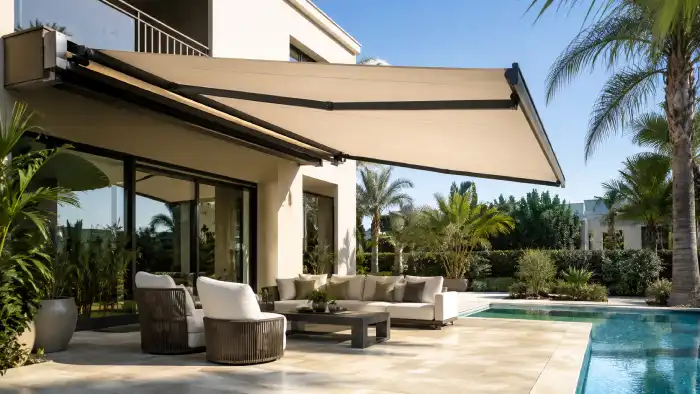
A retractable fabric sunshade — also called a motorised awning or retractable canopy — operates on a completely different principle from a louvered pergola. A UV-resistant fabric is mounted on a spring-tensioned or motorised roller cassette fixed to a wall or post system. When activated, the fabric extends outward on aluminium guide arms until it covers the intended area. When retracted, it rolls back into the cassette housing completely — the space returns to open sky.
The key operational difference from a louvered system: the retractable awning has two positions — deployed or retracted. There is no intermediate position control, no chimney effect ventilation, and no waterproof closed position for most standard fabric systems. PVC-coated waterproof fabrics provide rain protection when deployed, but standing water on the fabric surface requires careful pitch management to drain correctly without sagging. Shade mesh fabrics — which filter UV without blocking light entirely — do not provide rain protection but create a comfortable diffused light environment.
Retractable fabric systems are a practical shade option in Dubai when the priority is UV protection, lower cost, and lightweight installation rather than full weather management.
Practical Advantages
Where fabric systems work well
Lower Installation Cost
Significantly lower cost than a structural louvered pergola for the same covered area. The cost gap is substantial.
Reversible Installation
Suitable for rented properties and situations where a permanent outdoor structure is not desired.
Lightweight Structure
Suitable for upper floor balconies and terraces where structural load restrictions may apply.
Replaceable Fabric
Fabric can be replaced without changing the mechanism, allowing colour or material updates when desired.
Minimal Fixing Requirement
Wall-mounted cassette systems require minimal fixing and do not need post foundations or ground anchoring.
Practical Limitations
Where fabric systems need caution
No Intermediate Shade Control
Most systems are either fully deployed or fully retracted, with limited control between the two positions.
Limited High-Wind Suitability
Guide arm systems are not rated for sustained wind loads in the same way as structural louvered systems.
Fabric UV Lifespan
Quality UV-resistant technical fabrics last around 5 to 8 years in Dubai conditions. Inferior fabric may degrade within 2 to 3 years.
No Internal Drainage
Rainwater runs off the fabric edge, which can create issues depending on the deployment pitch and terrace layout.
Retractable fabric systems are the right choice for compact terraces and balconies where the goal is UV shading rather than full weather management, and where cost or structural constraints make a full louvered system impractical.
3. Bioclimatic Pergola — the automated climate management system
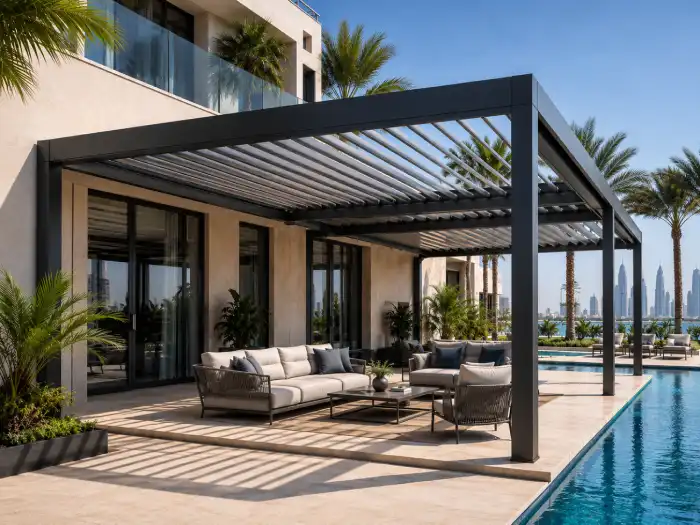
A bioclimatic pergola is a louvered aluminium system — the same blade rotation principle as the standard louvered pergola described above — but engineered specifically for automated microclimate management rather than manual control. The distinction matters:
In a standard louvered pergola, the user controls the blade position based on their perception of conditions. In a bioclimatic system, the pergola responds autonomously to environmental data. Built-in or externally mounted sensors continuously monitor rain (closing the blades immediately when rain is detected), wind speed (securing the structure when speed exceeds safe operating thresholds), sun intensity (adjusting blade angle to maintain a target illuminance level), and temperature (opening for ventilation when internal temperature rises above a set point).
The result is that a properly configured bioclimatic system manages the outdoor microclimate without the user needing to interact with it. The pergola opens on a clear morning to bring in light, tilts in the afternoon to filter the low western sun, closes when a brief rain passes, and reopens automatically when conditions clear. In a high-end hospitality environment — a hotel terrace or restaurant outdoor dining space — this automation is not just convenient; it is operationally important: staff does not need to monitor and manually adjust the system throughout service.
Bioclimatic Pergola Integration
A bioclimatic pergola is not only a weather-response system. It can work as part of a complete outdoor living setup with smart controls, programmed scenes, side enclosures, lighting, and concealed drainage.
Best for luxury villa outdoor rooms, hotel pool terraces, restaurant dining areas, and large commercial outdoor zones where manual pergola control is not practical.
Smart Home Integration
Control4, Crestron, KNX, Lutron and similar building management systems can include the pergola as a controlled outdoor zone.
Automatic Response
The system can respond to occupancy sensors, time-of-day schedules, and scene settings for more convenient daily use.
Voice Control
Amazon Alexa and Google Home integration allows spoken commands to adjust the pergola position or activate a saved scene.
Custom Scene Programming
Morning coffee at 45° blades, afternoon dinner at 80° blades, or evening mode with LEDs on and blades closed can be saved as single-button scenes.
Motorised Side Enclosures
Frameless sliding glass panels, retractable fabric screens, or zip-track insect barriers can connect to the same control system.
Concealed Drainage
Rainwater is channelled internally through beams and posts, using the same internal drainage principle as standard louvered pergolas.
Premium Aluminium Profile
The aluminium profile used in bioclimatic systems is usually a heavier structural grade than entry-level louvered systems, reflecting the premium engineering specification throughout.
Dubai Use Cases
Ideal for luxury villas, hotel terraces, restaurant outdoor dining, and large commercial spaces where automated weather response and zone control are important.
4. Fixed Structure with Retractable Shade Element
This hybrid approach combines the visual permanence and architectural weight of a fixed pergola frame — in aluminium, timber, or steel — with a retractable or adjustable shade element in the roof position. The frame is permanent and structural; the roof element opens and closes as needed.
Shade element options for a fixed frame:
- Louvered insert panels — fixed frame, but the roof panels between the beams are louvered aluminium blades that can rotate, offering similar function to a louvered pergola at lower total cost for the right configurations
- Retractable fabric between the beams — individual fabric sections that retract toward the beams when not needed, leaving the frame visible and the sky open
- Sliding polycarbonate panels — solid panels that slide on runners to cover or uncover the roof opening
This approach suits properties where the fixed frame is part of an architectural feature — pergola columns that match the villa’s exterior language, a structural pergola that also supports planting or climbing plants — but where some flexibility in the shade coverage is desired without committing to a full motorised louvered system.
Free Site Visit Across Dubai
Need Help Choosing the Right Pergola System?
Share a photo of your outdoor space and approximate dimensions. Our team will review your area and recommend whether a fixed frame, retractable fabric shade, louvered pergola, or hybrid pergola system is the best fit.
Free site visit available across all Dubai communities.
What Separates a Quality Foldable Pergola from a Poor One in UAE Conditions
Dubai has a large number of pergola suppliers ranging from specialist installers with engineering expertise to general contractors who add pergola installation as a service without deep knowledge of the product. The gap in quality — and in long-term performance — between the best and worst is significant. Here is what to look at.
Aluminium grade and profile design
The aluminium profiles used in the frame — posts, beams, and blades — should be architectural-grade extruded aluminium (typically 6060-T5 or 6063-T6 alloy). These grades provide the yield strength needed to handle wind loads without deflection or permanent deformation.
Decorative-grade thin-wall extrusions — which look identical in a showroom photo — are lighter and cheaper to manufacture but flex under load, which causes blade alignment problems over time, water pooling in the drainage channel, and, in extreme cases, structural failure in high-wind events.
Post dimensions matter. A quality louvered pergola system uses posts of at least 100mm × 100mm cross-section for standard spans; larger posts for longer spans or elevated installations. Ask for the post dimensions and wall thickness before committing — this is a specific question that separates suppliers who understand their product from those who do not.
Internal drainage design
The internal drainage system — gutters built into the main beams that channel rainwater through hollow posts — is the element that determines whether a louvered pergola functions as a weatherproof structure or merely a decorative shade element. The gutter capacity must be sufficient for Dubai’s rain events, which, while infrequent, are intense when they occur.
External edge drainage — where water from the blades runs off the perimeter of the structure rather than being channelled internally — is an inferior design. In a correctly engineered louvered system, no water exits from the blade or beam perimeter. If a supplier’s system has external drainage, the engineering is a generation behind current quality standards.
Motor specification and IP rating
Motors in outdoor installations are exposed to heat, humidity, and dust that degrade unrated motors quickly in Dubai conditions. Quality louvered pergola motors should carry a minimum IP54 rating (dust-protected and splash-resistant) and should be specified for operating temperatures up to 60°C — which a motor housing in direct sun in a Dubai summer will experience.
Motor torque should be specified for the actual blade weight and span length. An undersized motor that struggles to drive a full blade array will overheat and fail within months. Ask for the motor specification and IP rating — a supplier who cannot provide this information has not specified the motor correctly.
Powder coat specification
All aluminium elements should be powder-coated with a polyester powder coat rated for outdoor UV exposure in the UAE. The standard is QUALICOAT Class 2 or equivalent — a specification developed specifically for architectural aluminium in high-UV and coastal environments.
Standard industrial powder coat — which looks identical on the day of installation — will begin to fade and chalk within 3 to 5 years in the Dubai sun. Quality powder coat holds its colour and surface integrity for 10 to 15 years.
Wind load rating
Dubai experiences wind events that can reach 80 to 100 km/h in Shamal season (typically June to July) and during occasional convective storms. Pergola systems should be rated for the wind load appropriate to the installation location — higher for exposed rooftop installations, lower for sheltered garden terraces.
Ask the supplier for the wind load rating of the system in both open and closed positions — the ratings will differ. A system with wind sensors that automatically close at a preset wind speed protects itself from overload; a system without this feature depends on the user to close it in time.
Warranty terms
A quality manufacturer-backed louvered pergola system should carry a minimum 5-year warranty on the frame and mechanism, and a separate warranty on the motor. Extended warranties of 10 years on the frame are offered by premium manufacturers.
Read the warranty terms carefully — some warranties are voided by salt air exposure (relevant for coastal Dubai properties) or by installation at height above a certain level. Ask specifically what voids the warranty and whether the installation location is covered.
Foldable Pergolas by Dubai Community — What Works Where
Different Dubai communities and property types create different installation conditions. Here is what our experience across the city tells us about what works best where.
Arabian Ranches (AR1, AR2, AR3)
The most common brief in Arabian Ranches in 2026 is a louvered pergola over the rear garden terrace — replacing what was either a basic fixed shade structure or nothing at all. AR1 villa garden areas suit larger span louvered systems of 5m to 8m in width; AR2 and AR3 plots are typically more compact but still accommodate a meaningful covered outdoor zone.
Emaar NOC is required for all permanent pergola structures in Arabian Ranches. This is a straightforward process for pergolas that comply with Emaar’s design guidelines — we handle the submission as part of every project in this community. Approval typically takes 2 to 4 weeks before installation can proceed.
Dubai Hills Estate
Contemporary Dubai Hills villa architecture suits clean-line aluminium louvered systems with minimal visible hardware. White and dark bronze powder coat finishes are most commonly specified. Roof terraces in Dubai Hills apartment buildings have been the site of several retractable awning installations where structural constraints prevent a full louvered system. NAKHEEL approval is required for structural pergola installations.
Palm Jumeirah
Villa renovations on the Palm frequently include full outdoor living transformations where the louvered pergola is integrated with motorised glass sides, outdoor kitchens, and smart home systems. Premium specifications with bioclimatic automation are more common in Palm Jumeirah than in any other Dubai community. Nakheel Properties authority access and working regulations apply to all projects on the Palm.
The Meadows, The Springs, The Lakes
Older NAKHEEL communities with mature gardens and established outdoor spaces. Louvered pergola additions over existing paved terraces are common — often paired with landscape lighting and garden renovation as a combined project. NAKHEEL NOC required. Working conditions in these communities are well-managed, and our team has extensive experience delivering projects here.
JVC, Al Barsha, Mirdif, Nad Al Sheba
More cost-conscious communities where retractable fabric awning systems are popular alongside entry-to-mid-range louvered systems. Villa plots vary considerably in size. Access is generally straightforward. Community approval requirements are less uniformly enforced than in Emaar and NAKHEEL communities but should always be confirmed before installation starts.
Commercial — restaurants, hotels, rooftops
Commercial foldable pergola installations in Dubai have specific requirements that residential installations do not. Higher foot traffic means the mechanism must tolerate more frequent operation cycles — a residential system that opens and closes twice a day has a very different duty cycle from a restaurant terrace system that operates 20 times a day, seven days a week.
We specify commercial-grade systems with higher-rated motors and heavier aluminium profiles for all non-residential applications. Dubai Municipality and relevant authority permits are required for commercial outdoor shade structures.
Maintenance — What Each System Actually Needs Long-Term
Maintenance is the section most pergola guides leave out. A foldable pergola is a mechanical system with moving parts, an electrical motor, and outdoor surface finishes exposed to Dubai’s heat, UV, and occasional dust storms. Knowing what maintenance it needs — and planning for it — extends the system’s life and prevents the repair costs that come from neglect.
Louvered and bioclimatic systems
Annual maintenance requirements for a louvered pergola system in Dubai:
- Cleaning of blade surfaces — sand and dust accumulate on the upper face of the blades over time. An annual wash-down with a mild detergent and soft brush removes this before it becomes abrasive and scratches the powder coat surface
- Internal gutter inspection and cleaning — leaves, sand, and debris can accumulate in the internal gutters and partially block the drainage path to the post drains. An annual check and clear-out prevents water backing up during rain events
- Motor mechanism lubrication — the blade pivot points and drive mechanism benefit from an annual lubrication with the manufacturer-specified lubricant. This prevents wear and maintains quiet, smooth operation
- Motor inspection — check that the motor runs through its full cycle in both directions without hesitation or unusual noise. Address any issues before a stuck motor creates a larger fault
- Blade alignment check — confirm all blades close in parallel and seat correctly on their interlocking seals. Misaligned blades allow water penetration at the seam and should be adjusted before the wet season
Bioclimatic systems additionally require:
- Sensor cleaning and calibration — rain, wind, and sun sensors should be cleaned and function-tested annually
- Control system firmware update — check for available updates to the controller software and app
Retractable fabric systems
- Fabric cleaning — every 2 to 3 months in Dubai conditions. Sand and desert dust settle on the fabric surface and, if left, become abrasive when the fabric retracts and extends. Brush off loose dust and rinse with clean water
- Retraction mechanism lubrication — the roller mechanism and guide arm joints should be lubricated annually with silicone spray
- Fabric inspection — check for any tears, seam separation, or UV degradation annually. Quality technical fabrics show consistent colour for 5 to 8 years; early fading or brittleness indicates the fabric is nearing replacement
- Guide arm tension — check that the fabric deploys flat without sagging or side-pulling, which indicates guide arm adjustment is needed
Community NOC and Authority Approvals — What Pergola Installations Require
This is a question almost every Dubai homeowner asks, and almost no pergola guide answers properly. Here is the accurate position as of 2026:
Managed villa communities (Emaar, NAKHEEL, DAMAC)
In all Emaar-managed communities (Arabian Ranches, Dubai Hills, Emaar South), all NAKHEEL-managed communities (The Meadows, The Springs, The Lakes, Palm Jumeirah, JVC), and DAMAC communities (DAMAC Hills, Akoya Oxygen), any permanent external structure added to a villa requires a community management NOC before work starts. This applies to louvered pergola systems, bioclimatic systems, and fixed structures. Retractable awning systems are sometimes treated differently — check the specific community guidelines.
The NOC process involves submitting drawings showing the proposed structure, its dimensions, materials, colours, and position relative to the villa and boundary walls. The developer design guidelines specify maximum heights, setback distances from boundaries, and approved material finishes — structures must comply with these guidelines to receive approval.
Flowers Yard Landscaping manages the NOC application process for all relevant projects as part of our service. We prepare the required drawings, submit them to the community management portal, follow up on the approval, and ensure written approval is in place before any installation begins. We do not start construction without confirmed NOC — attempting to install without approval risks being required to remove the structure at your own cost.
Non-managed communities and independent villas
For properties in non-managed communities or independent plots without a developer community management body, the relevant authority is Dubai Municipality. DM permits are required for permanent external structures above certain dimensions. We advise on the specific DM requirements for each property during the site visit — requirements vary based on the structure height, footprint, and the nature of the fixing to the villa.
Commercial properties
Commercial pergola and shade structure installations require Dubai Municipality structural permits and in some cases, Civil Defence approval where the structure affects means of escape or fire compartmentation. Free zone properties in DIFC, DMCC, and similar authorities have their own approval processes. We manage all relevant authority submissions for commercial projects.
How to Choose the Right Foldable Pergola System for Your Space
This is the question that most people searching ‘foldable pergola dubai’ actually want answered. Here is a framework for making the decision that goes beyond a simple bullet list.
Start with how you actually use the outdoor space
The single most important question is not which system looks best in a catalogue — it is how the outdoor space is used. A family that uses the terrace for breakfast every day in winter and for evening dining with guests has very different requirements from a homeowner who wants the space to look attractive and occasionally sits outside in the cooler months.
If you use the outdoor space frequently and through different weather conditions — you want a louvered motorised system that gives you meaningful control. If you want basic UV protection for occasional use and the space is not your primary outdoor living area — a retractable awning may be entirely sufficient.
Consider the sun orientation of your outdoor space
South-facing terraces in Dubai receive direct overhead sun through the middle of the day and are the easiest to manage with any system. West-facing terraces receive low-angle late afternoon sun that penetrates under any overhead shade structure — a louvered system with optional side screens is far more effective for west-facing spaces than an awning system that only covers the overhead plane.
East-facing terraces receive morning sun that is generally manageable without shade in the cooler months. North-facing terraces in Dubai receive very little direct sun and may not need a shade structure at all — the question is more about rain protection and creating an enclosed feel.
Assess the structural conditions
A full louvered pergola is a structural installation that requires ground anchoring for post foundations, or structural wall fixing for attached systems. The ground type, the existing surface, and the proximity to underground services all affect the feasibility and cost of the installation.
Rooftop terraces have weight restrictions that may rule out heavy structural systems. Rented properties cannot have permanent ground anchors installed without landlord approval. Compact terraces where post positions would obstruct the space significantly may suit a wall-mounted awning system better than a free-standing louvered pergola.
Match the system specification to the use intensity
A domestic villa pergola that opens and closes twice a day requires a very different motor and mechanism specification from a restaurant terrace system that cycles 20 or more times a day, seven days a week. Specifying a residential-grade system for a commercial application will result in premature motor failure and mechanism wear within months.
Always tell your pergola supplier the intended use intensity — not just whether the installation is residential or commercial, but how frequently the system will actually be operated. A frequently used residential system in a family home with several children may warrant commercial-grade specification for the motor even in a villa context.
What to Ask Your Pergola Contractor Before Committing
Not all pergola contractors in Dubai have equivalent knowledge of the systems they sell. These questions separate a contractor who understands the product from one who is reselling a kit they do not fully understand.
- What aluminium alloy and profile wall thickness is used for the posts and beams? — Structural grade 6060-T5 or 6063-T6 with appropriate wall thickness for the span
- Is the drainage internal through the posts, or external edge drainage? — Internal drainage is the correct answer for any quality system
- What is the wind load rating of this system, in both open and closed positions? — Should be specified in kPa or km/h and appropriate for the installation location
- What is the IP rating of the motor? — Minimum IP54 for outdoor installation; IP65 for exposed or coastal locations
- What powder coat specification is used, and is it QUALICOAT rated? — Architectural-grade powder coat is standard for quality systems
- What are the warranty terms — frame, mechanism, and motor separately? — And what installation conditions or uses void the warranty?
- Do you provide 3D design visuals before fabrication? — Any contractor fabricating custom dimensions should provide these for approval
- Do you handle the community NOC application? — And have you done it before in this specific community?
- Is the installation team directly employed or subcontracted? — Affects accountability for quality and any post-installation issues
A professional contractor who understands foldable pergola systems answers every one of these questions clearly, specifically, and without hesitation. Vague answers, deflection, or inability to provide technical specifications are significant warning signs.
Frequently Asked Questions
1- How long does a foldable pergola installation take?
Most residential foldable louvered pergola installations for a standard villa terrace are completed in 2 to 4 days once the system has been fabricated. The manufacturing lead time after design sign-off is typically 3 to 5 weeks for custom-sized systems.
Total project duration from first site visit to installation completion is usually 5 to 8 weeks. Projects requiring community NOC approval should add 2 to 4 weeks for the approval process before installation can begin.2- Can a foldable pergola withstand Dubai’s Shamal winds?
Quality louvered pergola systems are engineered for UAE wind load requirements. Most residential systems are rated for 80 to 100 km/h in the closed position. Wind sensors that close the blades automatically when wind speed exceeds a safe operating threshold are strongly recommended for Dubai installations — they protect the system from overload without requiring the user to monitor conditions. In the fully closed position, a correctly installed quality system handles normal Shamal conditions without issue. In an exposed rooftop installation with higher wind exposure, a reinforced heavy-duty specification may be recommended based on the site assessment.
3- Can a foldable pergola be installed on a rooftop terrace?
Yes, but rooftop installations require careful consideration of structural load capacity, the integrity of existing waterproofing (post bases penetrate the roof surface and must be correctly detailed to maintain waterproofing), and wind exposure at height. We assess all of these during the site visit before recommending a system specification for rooftop applications. Retractable awning systems are sometimes more appropriate for rooftops where structural load is a concern.
4- Does a louvered pergola provide full waterproof protection when closed?
A quality louvered pergola with correctly interlocking blades, rubber blade seals, and a functioning internal drainage system provides effective waterproofing against standard rain events when in the fully closed position. The important qualifiers: the blades must be properly sealed at the interlock points — worn seals allow water through; the internal drainage must be clear — blocked drains cause water to back up and overflow the gutter; and in extreme horizontal rain driven by very strong wind, some ingress at the perimeter beam joints is possible in lower-specification systems. Quality systems with correctly maintained seals perform very well in Dubai’s rain events, which are typically vertical rather than wind-driven.
5- Is a bioclimatic pergola worth the additional cost over a standard louvered system?
For residential applications where manual control is perfectly practical — pressing a remote when the weather changes — a standard motorised louvered system delivers the same functional result as a bioclimatic system at lower cost.
The bioclimatic premium makes genuine sense in three situations: large covered areas with multiple pergola zones that would be impractical to manage manually; commercial applications where automated weather response removes staff responsibility; and smart home integrations where the client wants the pergola to be part of a whole-home automation ecosystem.
For a single residential terrace where you use the space personally and are happy to operate a remote, the standard louvered system is usually the better value decision.6- Can I add side screens to a louvered pergola?
Yes — and this is one of the most popular upgrades. Side screens can be added during the initial installation or retrofitted to most quality louvered systems afterward. Options include retractable fabric screens (roll up into a head box when not needed), fixed fabric panels on tensioned frames, and motorised glass or polycarbonate sliding panels.
For a Dubai terrace facing west or northwest, side screens on the sun-exposed face make a dramatic difference to the usability of the space during late afternoon hours when overhead shade is not sufficient.7- What happens to a louvered pergola during a Dubai sandstorm?
In advance of a haboob or sandstorm, the correct position for a louvered pergola is fully closed — blades interlocked to prevent sand ingress into the mechanism. After the sandstorm passes, a wash-down of the blade surfaces and a check that the internal drainage channels are clear of sand accumulation is recommended before returning the system to normal operation. Sand that enters the mechanism and dries in the blade pivot points can cause stiffness in the drive — this is resolved with a clean and lubrication of the affected pivot points.
8- What is the lifespan of a quality louvered pergola in Dubai?
A quality aluminium louvered pergola installed with structural-grade profiles, UV-rated powder coat, and correctly specified motors should provide 15 to 20 years of functional service with proper annual maintenance. The components with the shortest lifespan are the motor (which may need replacement at 8 to 12 years of normal residential use) and the blade interlocking seals (which should be inspected annually and replaced when elasticity is lost — typically at 7 to 10 years). The aluminium frame itself, with quality powder coat, should outlast all other components by a significant margin.
Get a Free Foldable Pergola Consultation in Dubai
Flowers Yard Landscaping installs foldable louvered pergola systems, retractable sunshades, and bioclimatic structures across Dubai for villa owners, restaurant operators, hotels, and commercial properties. Every installation begins with a proper site assessment — we look at the space, the sun orientation, the structural conditions, and how you use the area — and recommend the system that fits the situation, not the most expensive option on the catalogue.
We manage Emaar, NAKHEEL, and DAMAC community NOC applications, fabricate in our Dubai workshop, install with our directly employed team, and provide a workmanship guarantee on completed installations. We serve all Dubai communities and can usually arrange a site visit within 2 to 3 working days.
Free Site Visit Across Dubai
Need a Foldable Pergola or Sunshade for Your Outdoor Space?
WhatsApp us a photo of your outdoor space and its approximate dimensions. We will give you an initial view and confirm a visit time within a few hours.
Free site visit — all Dubai communities