
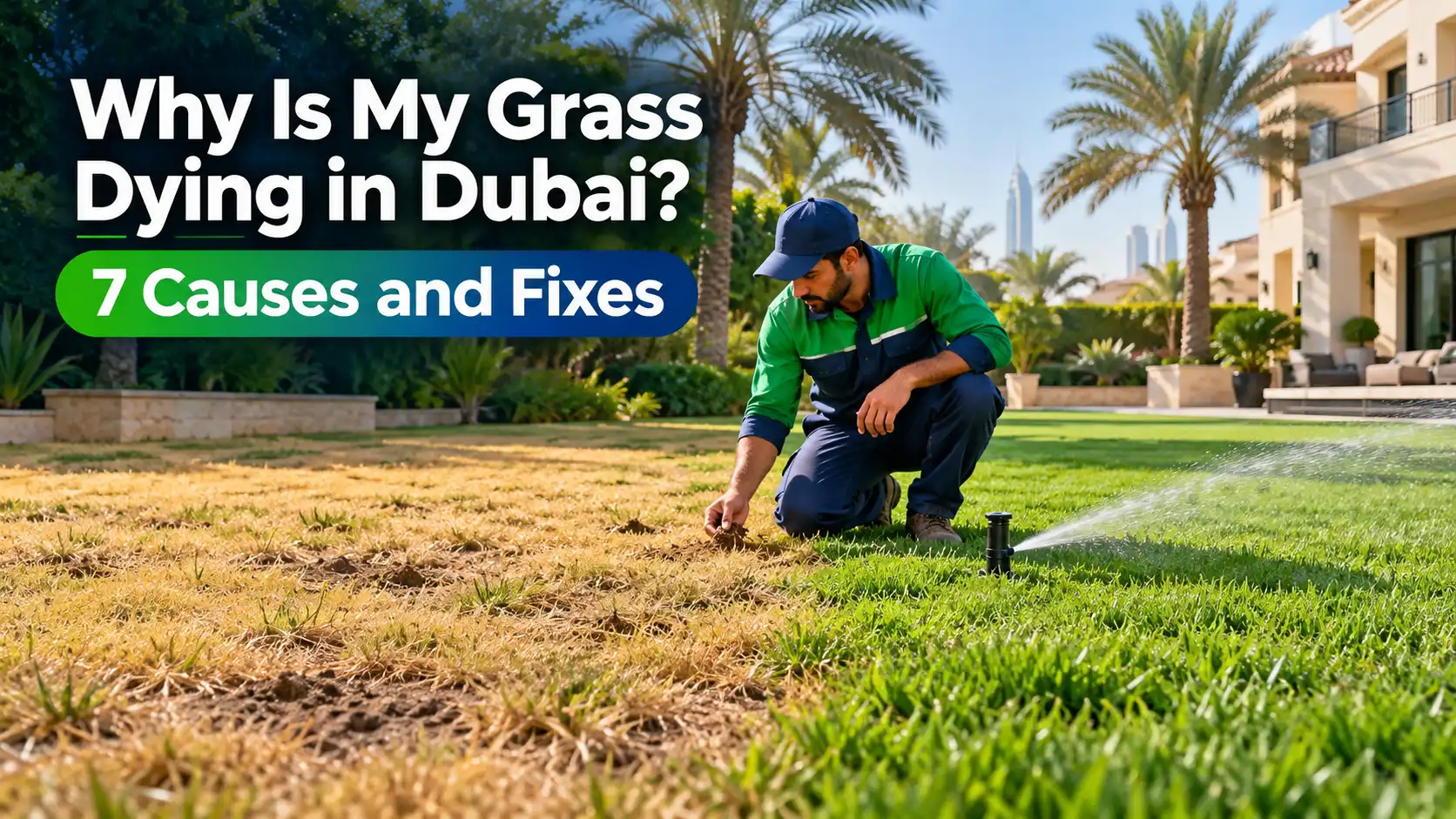
A dying lawn in Dubai almost never has one cause. Usually, one thing goes wrong, such as a blocked emitter or a zone that has drifted out of balance, and the heat turns it into a bare patch within a couple of weeks.
The good news is that lawns fail in recognisable patterns. The shape and location of the damage tells you a great deal before anyone digs anything up. Here are the seven causes we find most often on villa gardens, in roughly the order we check them.
Start here: Read the Pattern
Before assuming anything, look at where the grass is dying.
- Circular or fan-shaped dead patches: almost always irrigation coverage, either the gap between two sprinkler arcs or a blocked emitter.
- Straight-edged strips: these follow a buried line, either a failed irrigation run or something below the surface the roots cannot get past.
- Damage worst along walls and paving edges: reflected heat, and usually salt accumulation with it.
- Thinning evenly across the whole lawn: watering schedule, soil condition, or the grass species itself, not a mechanical fault.
- Worst in shaded areas: a light problem, not a water problem. Watering more will make it worse.
That one observation will usually narrow it to two possibilities.
CAUSE 1
Irrigation Coverage Gaps
This is the most common cause by a wide margin. A correctly installed sprinkler system waters in overlapping arcs, so every point on the lawn is reached by at least two heads. Over time, heads sink, get knocked out of alignment by mowing, or become partially blocked, and the overlap disappears.
How To Check
Place a few empty tins or straight-sided containers around the lawn and run a normal cycle. Measure what collects in each. If one holds half what another does, you have found your dead patch.
The Fix
Clean and re-align the heads, raise any that have sunk below turf level, and re-check the arcs. If pressure has dropped across the whole system, that is a separate problem (cause 2). See our irrigation services if the system needs more than adjustment.
CAUSE 2
Water Pressure That No Longer Matches the System
Sprinkler heads throw a particular distance at a particular pressure. Drop the pressure and the arc shortens, pulling water away from the outer edge of every zone at once. The lawn then dies in a ring, furthest from each head.
Pressure drops for mundane reasons: a partial blockage in the mainline, a filter nobody has cleaned, an underground leak, or more zones added to a system sized for fewer.
The Fix
Measure pressure at the furthest point in the system, not at the tap. If it is below what the heads need, find the restriction rather than adding a pump. A pump on a blocked line just moves the problem.
CAUSE 3
Watering Little and Often
This is the most common self-inflicted cause, and it feels like the right thing to do in a hot climate. Short daily watering wets only the top few centimetres of soil. Grass roots grow toward water, so they stay shallow, and a shallow-rooted lawn has no reserve. The first hot day or missed cycle, and it browns off within days.
The Fix
Water less often and for longer, so moisture reaches the full root depth each time. Change the schedule gradually, and expect the lawn to look slightly worse for a week or two before it improves.
Also check when it runs. Midday watering loses a significant share to evaporation before it reaches the roots. Late evening watering leaves the blade wet overnight, which is how fungal problems start. Early morning avoids both.
CAUSE 4
Salt Build-up in the Soil
Every litre of irrigation water carries dissolved salts. The water evaporates; the salts stay. Over months and years they concentrate in the root zone, and once the concentration is high enough the grass cannot draw water even when the soil is wet.
The signs are distinctive: the lawn looks drought-stressed despite being watered, damage is worst along bed edges and against paving, and you may see a pale crust where water has been evaporating.
The Fix
Periodic deep watering to flush salts below the root zone. This only works if the soil drains. If it does not, correct drainage first or you are simply moving the salt around.
CAUSE 5
Compacted Soil
Compaction is easy to miss because it looks like nothing. The lawn thins, water sits on the surface longer than it should, and new growth never quite fills in. It happens where people walk repeatedly, where furniture sits, and on any lawn laid over ground compacted during construction and never broken up, which describes a great many new-build villa gardens (see how we prepare the base on this Tilal Al Ghaf project).
How To Check
Push a screwdriver into the soil a few hours after watering. If it goes in easily you are fine. If you have to lean on it, the soil is compacted.
The Fix
Aeration, followed by a top dressing of sand or a suitable sandy mix brushed into the holes. On severely compacted ground the only reliable answer is to lift the turf, break up and amend the base, and relay.
CAUSE 6
Grass in the Wrong Place
Most turf grasses used in UAE lawns need a lot of light. In the strip between two boundary walls, under a mature tree, or along the north side of a villa, there is often not enough, and no amount of watering or feeding will change that. A lawn that is healthy in the open and thin in the same shaded corner year after year is not sick. It is in the wrong place.
The Fix
Accept it and design around it. Shade-tolerant planting, a paved or gravel surface, or artificial grass, which looks the same in shade as in full sun, all solve it permanently. For a no-lawn option that needs no mowing, see our pebble garden in Nad Al Sheba .
CAUSE 7
Fungal Disease
Fungal problems show up as patches with a distinct edge, sometimes ringed, often appearing suddenly after a period of high humidity. They are far less common than irrigation faults, which is why they come last. Most lawns diagnosed as “diseased” turn out to have a coverage problem.
The Fix
Correct the conditions first: stop evening watering, improve airflow if planting has grown in around the lawn, and reduce excess nitrogen. Treat chemically only once the cause is dealt with, otherwise it returns.
Other Causes to Rule Out
If none of the seven fits, check these before looking further. They are less common, but each can mimic the patterns above.
- Uniform pale yellow across the whole lawn: often a nutrient shortage, typically nitrogen. Feed lightly once the watering is right.
- Streaks that follow a spreader pattern: fertiliser burn from uneven or heavy application.
- Small, dark-ringed yellow spots: pet urine, usually where a dog returns to the same place.
- Frayed, tan-tipped blades: mowing too short or with a blunt blade, which strips the leaf the grass needs.
- Irregular patches that peel back like loose carpet: root-feeding pests, which need identifying before treatment.
- Spongy brown mat under the blades: thatch build-up starving the roots.
Our guide to 10 common garden problems in Dubai covers pests and plant health in more detail.
What To Do This October
Summer damage is easiest to see now, and the cooler months are the best repair window. Fix the cause first (irrigation, schedule, drainage), then overseed natural lawns in October and November so new grass can establish before next summer. Overseeding without fixing the cause just feeds the same failure. Reduce watering gradually as temperatures drop; our October garden checklist covers the full sequence.
When to Replace rather than Repair
If more than roughly a third of the lawn is gone, or the same patches have failed two years running after being repaired, repair is usually the more expensive route. At that point the underlying issue is the base, the drainage or the irrigation design, and patching the surface will not hold. It is also the point to decide honestly whether a lawn is the right surface for that part of the garden at all.
Getting it Diagnosed Properly
Most of the checks above you can do yourself in an afternoon. If the pattern does not match anything here, or the lawn keeps failing after you have corrected the obvious things, the problem is usually below the surface: base construction, drainage, or a fault in the irrigation design rather than the hardware.
We survey lawns across Dubai and will tell you what is actually wrong, including when the answer is that nothing needs replacing. Our garden maintenance team can also take over ongoing care once it is fixed.
Frequently Asked Questions
1- Why is my grass turning yellow or brown in Dubai?
The most common cause is an irrigation fault such as uneven coverage or low pressure. Other frequent causes are watering little and often, salt build-up, compacted soil and too little light. The pattern of the damage usually points to the cause.
2- Is yellow grass dead?
Not necessarily. Yellow grass can be stressed or dormant rather than dead. Tug a few blades: if they come away easily and the crown at the base is dry and brittle, that patch is likely dead. If the crown is firm and slightly green, it can usually recover once the cause is fixed.
3- How often should I water my lawn in Dubai?
Less often than most people do, and for longer each time. The aim is to wet the full root depth on each cycle rather than the top few centimetres daily. Frequency changes through the year: a summer schedule run through winter will drown the lawn.
4- Why is my grass dying even though I water it every day?
Daily watering is often the cause rather than the cure. It produces shallow roots, and in salty soil it concentrates salt in the root zone instead of flushing it through. Check coverage first, then schedule depth, then salt.
5- Can a dying lawn be saved or does it need replacing?
If the cause is irrigation, scheduling, or compaction, most lawns recover once it is corrected. If the base or drainage is wrong, or the same areas have failed repeatedly, replacement is usually cheaper than continued repair.
6- When is the best time to repair a lawn in Dubai?
October and November. Cooler temperatures give new grass the whole cool season to establish before summer. Fix the cause of the damage first; otherwise, the repair fails again.