Most Dubai villa gardens were designed and planted when the property was first built or first occupied — often 5, 10, or even 15 years ago. The paving that looked clean and modern in 2012 is cracking and stained today. The grass that was green in autumn stopped recovering from summer years ago. The irrigation system that worked when it was installed has failed zones, blocked emitters, and a controller that nobody has touched since it was set up.
This is the reality of outdoor spaces in Dubai. The heat, the UV, the saline water, and the sandy soil are hard on everything — and gardens that are not actively renovated deteriorate steadily over time until they reach the point where a refresh is no longer enough.
If your garden has reached that point — or if you simply want to transform an outdoor space that was never quite right into one that genuinely works for your family — this guide is for you. It explains what a garden renovation in Dubai actually involves, what determines the cost, what different renovation scopes look like, and what to expect from the process.
Flowers Yard Landscaping completes garden renovation projects across Dubai villa communities. Everything in this guide is based on real renovation work we deliver every week.
What Is a Garden Renovation? How It Differs from New Landscaping and Maintenance
These three terms describe completely different scopes of work — and mixing them up leads to the wrong expectations and the wrong budget.
Garden renovation
Renovation means transforming an existing outdoor space that is no longer working as it should. It involves assessing what exists, identifying what needs to be demolished and removed, deciding what is worth retaining, and rebuilding or upgrading the space to a new standard. Renovation always starts with something already there — paving, planting, irrigation, structures — and works with and around those existing conditions.
The renovation mindset is: what is broken, what is outdated, what is missing, and what would transform how this garden is used?
New garden landscaping
New landscaping means building garden features from scratch — on a bare plot, in a space that has never been landscaped, or after a full demolition where everything existing has been removed. If you are starting completely fresh, our guide to garden landscaping in Dubai covers that scope.
Garden maintenance
Maintenance means the regular, scheduled care of a garden that is in good condition — mowing, trimming, irrigation adjustments, feeding, and general upkeep. Maintenance keeps a good garden performing. It cannot fix a garden that has deteriorated beyond a certain point. When maintenance is no longer keeping the garden in acceptable condition, renovation is the answer — not more maintenance.
| Quick test: If your garden looks noticeably worse every year despite regular maintenance, renovation is overdue. Maintenance is a running cost for a healthy garden. Renovation is the investment that makes it healthy again. |
7 Clear Signs Your Dubai Garden Needs Renovation — Not Just a Clean-Up
Many villa owners delay renovation by managing symptoms: a fresh coat of paint on a crumbling wall, replacing individual dead plants, repeatedly repairing irrigation emitters that keep failing. At a certain point, treating symptoms costs more than fixing the underlying problem. Here are the clear indicators that renovation is the right investment.
- Not surface dirt but structural failure of the tile, sub-base, or both. Once sub-base failure begins, patches worsen faster than they can be repaired. Paving is cracking, lifting, or staining permanently.
- If the grass is not returning green in October after summer dormancy, the soil, the irrigation, or both have broken down beyond recovery by overseeding or fertilising. Bare lawn patches that do not recover between seasons.
- Blocked emitters, broken zones, and pipes that have failed underground reach a point where repair is less cost-effective than replacement. An irrigation system past 8 to 10 years in Dubai conditions is typically at or near the end of life. The irrigation system runs, but plants continue to decline.
- Leggy, diseased, or simply outgrown their position. Some species decline in Dubai soil over time as salt accumulates around root systems. These need replacement, not pruning. Plants that are more than 8 to 10 years old are performing poorly.
- A garden with no pergola, no seating zone, and no evening lighting is not a space the family can use for most of the year. Adding these features is a renovation that transforms usability. The garden has no functional shade or living space.
- Drainage that was marginal when the garden was built fails progressively as soil compaction increases. Standing water damages roots, accelerates paving failure, and creates mosquito breeding conditions. Drainage problems need to be fixed before any other renovation work is done on top of them. Water pooling occurs after rain or irrigation.
- A garden designed for a household without children does not suit a family with three. A garden designed for decoration does not suit a family that wants to entertain outdoors. When the design and the usage are misaligned, renovation is the reset that fixes the mismatch. The design no longer matches how the household uses the space.
Free Garden Assessment
Not Sure If Your Garden Needs Renovation?
If three or more of these apply to your garden, the conversation with a landscaping contractor should be about renovation scope — not about which plants to replace.
A free site visit from Flowers Yard will give you a clear and honest assessment of which category your garden is in.
Send us your villa location and a short description of your garden issue. We will guide you on the next best step.
What Does a Garden Renovation Actually Involve?
Garden renovation is not a single type of work — it is a combination of elements, each addressing a different part of the outdoor space. Understanding what each element involves helps you build a realistic scope and avoid leaving problems in place that undermine the new work.
Demolition and removal
Every renovation begins with removing what no longer works. Failed paving, dead trees, broken irrigation pipework, outdated pergola structures, and collapsing retaining walls all need to be safely demolished, removed from the property, and disposed of correctly. This is the element of renovation cost that new landscaping does not have — and it is one of the first things assessed during a site visit.
Demolition also reveals what is hidden: the condition of the sub-base beneath old paving, the extent of tree root damage to drainage, the depth of old irrigation pipework, and any ground movement that has occurred over time. A thorough site assessment before quoting accounts for likely demolition discoveries rather than presenting them as extras after work starts.
Sub-base and drainage repair
The most important — and most frequently skipped — element of a renovation. If the sub-base beneath paving has failed, or if drainage has broken down, no new surface installed on top of it will last. Paving will crack again within two to three years. Water will pool in the same places.
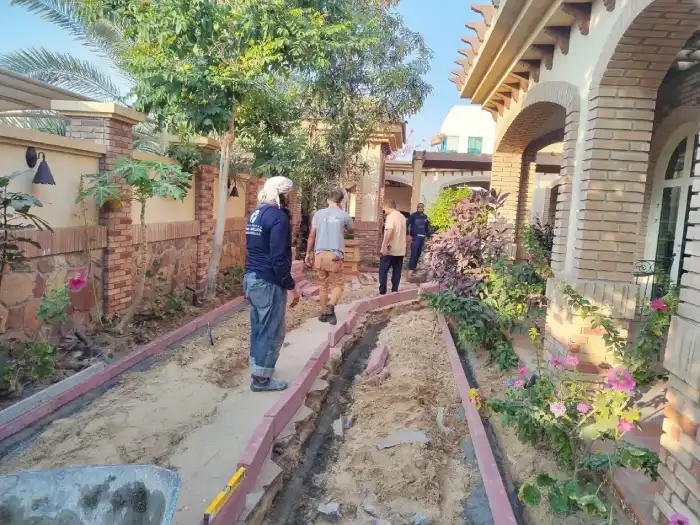
Sub-base repair means excavating below the existing level, removing failed material, compacting new aggregate base, and checking drainage fall before any new surface goes down. This adds to the renovation cost compared to a surface-only replacement — but it is the difference between a renovation that lasts 15 years and one that needs revisiting in 3.
Paving replacement
Removing old paving and laying new material is the most visible part of most hard landscaping renovations. Material options range from large-format porcelain tiles in contemporary finishes, to natural stone including sandstone, limestone, and travertine, to concrete pavers, composite wood-effect decking, and poured concrete with pattern or colour finish.
Material selection for a Dubai renovation needs to account for thermal expansion — tiles that do not handle the temperature range between winter nights and summer afternoons crack at the grout line or lift at the edges. Porcelain over a properly prepared base with the right joint spacing is one of the most durable choices for outdoor paving in Dubai. Natural stone adds character but requires sealing and more careful jointing.
Irrigation system replacement
An irrigation system past 8 to 10 years in Dubai conditions is typically at the point where full replacement is more cost-effective than continued repair. Pipes have brittled under UV exposure, emitters have blocked from mineral deposits in DEWA water, valves have failed, and the original zone layout no longer matches the current planting.
A full irrigation renovation means removing the old pipework, redesigning the system layout to match the current garden, installing new pipe and emitters, and fitting a smart controller with weather-based scheduling. A properly replaced irrigation system is the single most impactful investment in the long-term health of a planted garden in Dubai.
Planting renovation
Plants in Dubai gardens have a realistic lifespan of 7 to 12 years before they need replacement — less for species that struggle with saline water, more for hardy native and drought-tolerant varieties. Planting renovation involves removing declining plants and overgrown hedging, improving the soil in planting beds with organic amendment and, where needed, replacing the top layer of compacted sandy soil with fresh planting mix, and replanting with species appropriate to the current irrigation capability and sun exposure.
Mature specimen trees should be assessed individually. A healthy mature tree — particularly a large date palm, ghaf, or frangipani — is worth far more than any planted replacement and should be retained wherever possible. Sick or structurally unsafe trees need professional assessment before the renovation begins.
Lawn renovation or replacement
Natural grass lawns in Dubai deteriorate through a combination of soil compaction, uneven irrigation, salt accumulation, and heat stress. Renovation options range from aeration, scarification, top-dressing, and overseeding — which improves a lawn that is still fundamentally viable — to complete removal and replacement.
Replacement options are either a new natural lawn with improved soil preparation and a new irrigation design, or a switch to premium artificial grass. Most Dubai villa owners who have managed natural grass through multiple summer cycles choose artificial grass when they renovate the lawn — eliminating the irrigation cost, the mowing schedule, and the seasonal decline cycle permanently.
Adding features that were never there
Many renovation projects are not just about fixing what has broken — they are about adding what was never included. A villa garden that was finished to a basic standard when the property was built often lacks the features that make it genuinely usable: a pergola or shade structure, a properly designed outdoor seating and dining zone, landscape lighting for evening use, a water feature for atmosphere, or a BBQ and outdoor kitchen for entertaining.
Adding these features as part of a renovation — while the garden is already being worked on — is significantly more efficient than adding them separately. Infrastructure like electrical conduits for lighting and irrigation pipework can be laid at the same time as paving and planting, rather than cutting through a finished surface later.
Boundary wall and structure renovation
Boundary walls deteriorate visibly in Dubai — render cracks and lifts in the heat, paint fades and stains, coping tiles loosen and fall, and older walls sometimes crack at expansion joints or around posts. Wall renova
tion includes rerendering, repainting, replacing damaged coping, and repairing any structural cracks. Screen panels, trellis additions, and climbing plants trained on wall fixing systems are popular additions that improve privacy while adding a planted element without needing any ground space.
What Drives Garden Renovation Cost in Dubai?
The cost of a garden renovation depends on a different set of factors from new landscaping — because renovation always starts with assessing and dealing with what is already there.
Scale and depth of demolition required
Renovation cost begins with removal. Old paving, failed structures, overgrown trees, broken irrigation, and crumbling walls all need to be removed before new work can go in. The more extensive the demolition, the higher the starting cost. The scale of demolition is assessed during the site visit and detailed in the written quotation — it should not appear as a surprise extra once work begins.
What is worth retaining versus replacing
A skilled renovating contractor identifies what can be retained, repaired, or repurposed and what genuinely needs to be replaced. Keeping a sound concrete sub-base and tiling over it saves high cost versus demolishing it. Retaining a healthy mature tree avoids a replacement cost that would run to thousands of dirhams for an equivalent specimen.
Conversely, retaining a failing sub-base to save cost — then watching new paving crack within two years — creates a far more expensive outcome. The site visit is where these assessments are made honestly.
Size of the outdoor space
Larger gardens require more demolition, more new material, more irrigation, more planting, and more labour. A compact townhouse courtyard of 40 sqm is a very different scope from a large villa garden of 300 sqm with multiple outdoor zones. Size is the most straightforward factor in the renovation cost equation.
The gap between current state and intended outcome
The greater the distance between what the garden looks like now and what you want it to look like when finished, the higher the cost. A garden that needs paving refreshed and replanting done is a different project from one that needs full demolition, drainage correction, re-grading, new irrigation, new paving across 200 sqm, a pergola structure, outdoor lighting, a water feature, and complete replanting.
Being clear with yourself — and with your contractor — about which elements are essential and which are desirable but not urgent helps focus the renovation budget where it delivers the most impact.
Hard versus soft landscaping ratio
Renovations that are primarily about hard landscaping — replacing paving, building structures, pool construction, retaining walls — cost more per square metre than soft landscaping renovations focused on planting, lawn, and irrigation. Hard landscaping requires heavier base preparation, more precise installation, costlier materials, and more skilled labour.
Material specification
The same renovation scope delivers very different results — and very different costs — depending on the materials chosen. Standard concrete pavers versus premium natural sandstone. Economy artificial turf versus UV-rated premium pile turf. A basic powder-coated pergola frame versus a motorised louvered bioclimatic system.
For Dubai conditions, material specification is not just about aesthetics — it directly affects durability. A material that handles Dubai’s thermal range, UV exposure, and saline water well lasts significantly longer than a cheaper equivalent that looks the same on installation day. Discussing material specification for Dubai conditions — not just appearance — during the site visit is worth the time.
Community approval requirements
In gated villa communities across Dubai — Arabian Ranches, Dubai Hills, DAMAC Hills, Jumeirah Golf Estates, The Meadows, Palm Jumeirah, and others — structural changes to the exterior require a community management NOC before work can begin. This applies to pergolas, pools, boundary wall modifications, and significant external structures.
The NOC process itself does not typically add high cost, but it adds time — usually two to four weeks for approval. Renovation projects in managed communities need to account for this in the timeline. Flowers Yard manages the NOC application process on behalf of our clients for relevant projects.
Access
A villa with easy vehicle access for material deliveries and waste removal is significantly easier — and cheaper — to renovate than one with a narrow side passage, low gates, or long distances from the garden to where a vehicle can park. Access is assessed during the site visit and factored into the quotation before work starts.
Types of Villa Garden Renovation in Dubai — From Light Refresh to Full Overhaul
Most renovation projects fall into one of five categories depending on the scope of work involved. Understanding which category matches your garden helps set a realistic budget expectation before the site visit.
Type 1 — Patio and courtyard refresh
The lightest renovation type. Old paving is replaced with new material on a sound sub-base. Boundary walls are rerendered and repainted. Planting beds are cleared, soil is amended, and plants are replaced. The irrigation system is serviced and repaired rather than replaced. No new structures are added, and the garden layout stays the same.
This type of renovation suits gardens where the fundamentals — drainage, sub-base, layout — are sound, but the surfaces and planting have deteriorated. Typical for townhouse gardens and compact villa courtyards in communities where the original garden design still works well.
Type 2 — Feature addition renovation
An existing garden that functions reasonably well receives major new features that were never part of the original design. The most common additions: a foldable louvered pergola over the terrace, a water feature in an existing planting area, a full landscape lighting system, or a switch from natural grass to premium artificial turf.
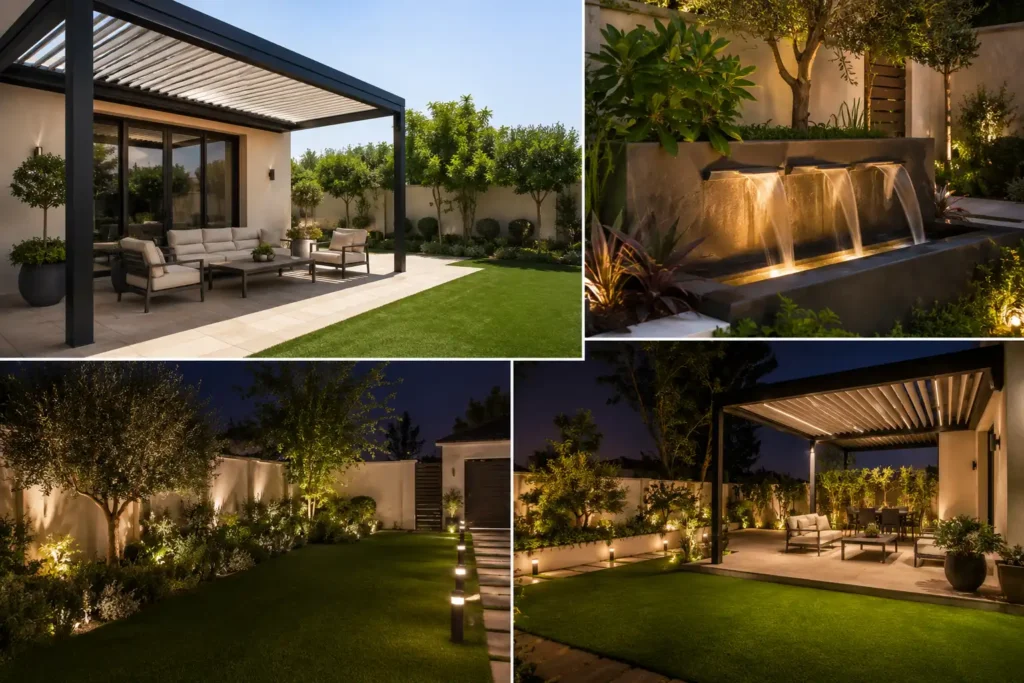
Feature addition renovations improve usability more than appearance. A garden that the family never uses after April because there is no shade becomes one they use year-round after a pergola is added. A garden that looks empty and flat after dark becomes a genuine evening space after lighting is designed and installed.
Type 3 — Outdoor living transformation
A more comprehensive renovation that creates a functional outdoor living space from a garden that was previously used mainly as overflow space or left empty. This typically combines paving renovation, a covered pergola and dining zone, built-in BBQ or outdoor kitchen, landscape lighting, artificial grass lawn, a water feature for atmosphere, and replanting with low-maintenance species. The result is a space the family uses every evening through the cooler months.
This renovation type adds genuine property value in addition to lifestyle value — a well-executed outdoor living space in a Dubai villa is one of the most impactful improvements a homeowner can make to the property’s appeal.
Type 4 — Pool addition to existing garden
A swimming pool is added to a garden that never had one. This is technically a renovation because existing garden elements need to be partially demolished to accommodate the pool excavation and construction, then reinstated around the new pool once complete. The surrounding garden — paving, planting, irrigation, and often a poolside shade structure — is redesigned as part of the project.
Pool addition projects require community management NOC in most gated Dubai villa communities. Flowers Yard manages this process as part of the project. Pool and garden combination projects are the most requested large-scope renovation in Arabian Ranches, Dubai Hills, and DAMAC Hills in 2026.
Type 5 — Complete garden overhaul
The most comprehensive renovation type. Everything is assessed — paving, drainage, sub-base, irrigation, planting, structures, walls — and everything that is not worth retaining is removed. The garden is effectively redesigned and rebuilt from the cleared space, with existing mature trees and sound structural elements retained where they add value.
A complete overhaul on a 15- to 20-year-old villa garden is the renovation equivalent of building a new garden — but faster and often less expensive because existing infrastructure like boundary walls, drainage connections, and electricity supply are already in place. This is the most common renovation type in Arabian Ranches Phase 1 and the older NAKHEEL communities where gardens are at the end of their original design life.
The Garden Renovation Process — What to Expect
Site visit and honest assessment
Every renovation starts with a site visit. We spend time properly assessing the garden — checking paving condition and sub-base integrity, running the irrigation system to identify failed zones and blocked emitters, examining plant health and root systems near proposed new work, checking drainage fall across the garden, and assessing access for material deliveries and waste removal.
We give you an honest picture of what we find — including the things that may complicate the scope or increase the cost, like a sub-base that needs full replacement rather than patch repair, or tree roots that would conflict with a proposed new feature. This honesty at the assessment stage is what prevents surprises once work starts. The site visit is free and takes 45 to 90 minutes depending on the garden size.
Renovation proposal and written quotation
Based on the site visit, we prepare a written renovation proposal covering what we recommend removing, what we recommend retaining, what we recommend rebuilding or adding, and the full itemised cost for each element. For more complex projects, we can prepare a design concept or layout drawing so you can visualise the result before approving the scope.
The quotation is itemised — you can see exactly what each element costs, which makes it straightforward to prioritise, adjust scope, or phase the work if needed. We do not submit lump-sum figures without a detailed breakdown.
Community NOC where required
For renovations involving structural additions — pergolas, pools, significant boundary modifications — in Emaar, NAKHEEL, or DAMAC managed communities, we prepare and submit the NOC application as part of the project. We coordinate with community management, follow up on the approval timeline, and confirm written approval is in place before construction begins.
Demolition and site preparation
The renovation begins with removal. Old paving is broken out, failed irrigation pipework is excavated and removed, dying trees are taken down, and broken structures are demolished. The site is then prepared for new work — sub-base repair and levelling, soil improvement in planting areas, irrigation pipe capping, and electrical conduit laying for lighting where required.
All demolished material is removed from the property and disposed of correctly. The site is clean and prepared before any new installation begins.
New installation in the correct sequence
Hard landscaping is always installed first: paving, structural walls, pool or pergola construction where applicable. Irrigation pipework and electrical conduits go in next, buried before surfaces are finished. Soft landscaping follows — planting, lawn installation, mulching and edging. Finishing elements complete the project: lighting fixtures, water feature installation, pergola roofing, and edge detailing.
Sequencing the work correctly prevents having to dig up or remove finished elements to reach infrastructure. It is one of the marks of a contractor who has managed renovation projects rather than just new installations.
Handover and aftercare
We walk every completed renovation with the client before handover. We run the irrigation system through a full cycle, confirm all lighting is operating correctly, check all paving edges and drainage flow, and address any snagging points before leaving site. We provide written guidance on caring for any new planting during the establishment phase and advise on the right maintenance schedule for what has been installed.
Most residential villa garden renovations are completed within 2 to 8 weeks from the start of demolition, depending on the scope. Projects involving community NOC approval should add 2 to 4 weeks before the on-site work timeline begins.
Garden Renovation Across Dubai Communities
Different villa communities in Dubai have different characteristics that affect renovation scope, timeline, and approach. Here is what to know for the most common communities we work in.
Arabian Ranches (AR1, AR2, AR3)
Arabian Ranches Phase 1 is the most active community for comprehensive garden renovation in 2026. Villas are 15 to 20 years old, gardens were planted in the early 2000s, and a significant proportion of those gardens are now past the point where maintenance alone keeps them in good condition. Irrigation systems have failed or are failing, paving has cracked and lifted, and original planting is either massively overgrown or has died back.
AR2 and AR3 tend to need feature-addition renovations rather than full overhauls — adding pools, pergolas, and lighting to gardens that are functionally sound but missing the elements that make them genuinely usable. All structural work in Arabian Ranches requires Emaar NOC. We handle this process for our clients.
Dubai Hills Estate
Dubai Hills villas are newer, but many are approaching the point where the developer-standard landscaping needs proper renovation. The most common brief combines artificial grass replacement, a pergola addition, landscape lighting, and irrigation system upgrading. NAKHEEL approval is required for structural work in Dubai Hills.
The Meadows, The Springs, The Lakes
These older NAKHEEL communities have mature gardens — many approaching 20 years — with well-established tree canopies that are a genuine asset worth protecting during renovation. The challenges are old irrigation systems, cracked paving from tree root movement, and boundary planting that has become structural in scale.
Comprehensive renovations in these communities almost always involve tree root assessment before paving and sub-base decisions are made.
DAMAC Hills, Jumeirah Golf Estates, Victory Heights
Golf estate communities tend to have large plots with established gardens, often including pools that need renovation alongside the garden. Pool renovation — tile replacement, coping renewal, equipment upgrading — combined with garden renovation is a common scope in these communities. Premium material specifications are standard. Developer approval processes vary by community.
Jumeirah, Palm Jumeirah, Jumeirah Bay Island
High-value coastal villa renovations in Jumeirah are typically complete outdoor living transformations — premium natural stone, custom water features, outdoor kitchens, and integrated smart home lighting. Plot sizes and budgets allow for more comprehensive scopes than inland communities. Community approval requirements vary by sub-community.
JVC, Mirdif, Al Barsha, Nad Al Sheba
More focused renovation briefs — paving refreshes, irrigation system replacement, artificial grass installation, and pergola additions — are the most common requests. Plot sizes vary considerably, and access is generally more straightforward than in larger gated communities.
How to Make Your Renovation Budget Go Further
Fix what is broken before adding what is new
The most common mistake in garden renovations is spending budget on visible improvements — beautiful new paving, fresh planting, a feature water wall — while leaving a failing irrigation system or a compromised sub-base in place. A new planting installed over a broken irrigation system will struggle within months. New paving over a failed sub-base will crack within years. Fix the infrastructure first. Then invest in what people see.
Prioritise ruthlessly — not everything needs doing at once
Work through the renovation scope with a clear priority hierarchy.
- First: anything that is causing active damage — drainage failures, structural cracks, irrigation that is drowning or starving plants.
- Second: infrastructure that enables everything else — paving sub-base, irrigation redesign, electrical conduits for future lighting.
- Third: the visible transformations — new surfaces, planting, features. Fourth: the finishes and details — lighting, water features, decorative elements.
This hierarchy ensures that money spent in phase one is not compromised by problems left in place from below it.
Phase sensibly if the full scope exceeds this year’s budget
A good renovation design is phaseable. Complete the paving, drainage, and irrigation in phase one — the infrastructure that makes everything else last. Add the pergola and planting in phase two. Add lighting and water features in phase three.
Infrastructure laid correctly in phase one accommodates later additions without having to be redone — electrical conduits buried now, irrigation manifolds sized for future zones, structural footings designed for a pergola that arrives six months later.
Choose materials that perform in Dubai — not just materials that look good
Two tiles can look identical in a showroom and perform very differently over five years of Dubai outdoor conditions. One handles thermal expansion and contracts cleanly without cracking the grout line.
The other lifts by year three. Ask your contractor specifically about the performance of each material in UAE outdoor conditions — not just its appearance or price. This conversation is worth having before materials are specified.
Get a properly itemised quotation and understand what you are buying
An itemised renovation quotation lets you see exactly where the budget is going and make informed decisions about where to upgrade and where to standardise. It also lets you ask specific questions about each line — what is included in the ground preparation cost, what material grade is specified for the paving, what irrigation controller is being installed. These questions protect you from shortcuts being taken in areas you cannot see.
Frequently Asked Questions
1- How much does a garden renovation cost in Dubai?
Garden renovation cost in Dubai depends on the size of the garden, the extent of demolition required, the current condition of the sub-base and irrigation, the features being added, and the material specification. A focused patio refresh with replanting is a fundamentally different scope from a complete outdoor living transformation with a new pergola, artificial grass, lighting, and a water feature.
We do not publish fixed renovation price lists because a figure without a site visit would not be accurate for your specific garden. What we offer is a free site visit and a detailed, itemised written quotation based on what your garden actually needs — usually provided within 48 hours of the visit.2- How long does a garden renovation take in Dubai?
A light refresh — paving replacement and replanting on a standard villa garden — typically takes 2 to 3 weeks. A comprehensive renovation including structural work, irrigation replacement, and new features takes 4 to 8 weeks from the start of demolition. Projects requiring community NOC approval add 2 to 4 weeks for the approval process before on-site work begins. We provide a clear project timeline in the written proposal before work starts.
3- Do I need NOC approval to renovate my garden in a Dubai villa community?
Soft landscaping work within your garden boundary — replanting, lawn replacement, irrigation repair — generally does not require formal approval. Structural additions and changes visible from outside the property — pergolas, pools, significant boundary wall modifications — require a community management NOC in most Emaar, NAKHEEL, and DAMAC-managed communities. Requirements vary by community. We advise on this specifically during the site visit and manage the NOC process for our clients where required.
4- Should I renovate my garden or start from scratch?
In most cases, renovation is more cost-effective when mature trees, sound boundary walls, and usable infrastructure are in place. Starting from scratch makes sense when fundamental problems cannot be resolved cost-effectively within the existing garden — deep drainage failure, severely invasive root systems, or a layout so poorly suited to the household’s needs that partial retention would be a compromise.
We give you an honest assessment of this during the site visit. We are not interested in recommending a scope larger than what the garden needs.5- Can I renovate just part of my garden?
Yes — and partial renovation is often the most practical starting point when the full scope is beyond the current budget. Renovating the outdoor living zone and paved terrace first delivers an immediate transformation of how the space is used, while the lawn and planting areas are addressed in a later phase. We design renovation projects to phase sensibly so that each stage integrates cleanly with the next.
6- Is garden renovation worth it for a rented property?
Soft landscaping renovation — replanting, irrigation repair, lawn replacement, non-structural improvements — is generally appropriate for rented villas with landlord agreement, as it improves the condition of the property. Structural additions require landlord consent.
Many Dubai landlords are open to approving permanent improvements that increase the property’s rental value. We recommend confirming the scope with your landlord before requesting a renovation quotation.7- How do I maintain a renovated garden in Dubai?
New planting needs careful irrigation management during the establishment period — typically the first full growing season. A newly installed smart irrigation system needs its schedule reviewed and adjusted through the first summer to match the actual water requirements of what was planted.
Once the garden is established, the maintenance requirement depends on what was installed. A garden with artificial grass and drought-tolerant planted beds needs far less intervention than a garden with a natural lawn and high-maintenance species. Flowers Yard offers ongoing garden maintenance contracts for post-renovation care across Dubai — covering irrigation management, planting care, and general upkeep.
Get a Free Garden Renovation Consultation in Dubai
If your garden is ready for a proper renovation — not just a tidy-up, but a genuine transformation that fixes what is broken and makes the outdoor space work properly for your household — start with a free site visit from Flowers Yard Landscaping.
We assess your garden honestly, tell you what it needs and what it does not, and provide a detailed written scope of work and quotation. No obligation, no pressure, no lump-sum estimate without a proper inspection.
We complete garden renovation projects across all Dubai villa communities — Arabian Ranches, Dubai Hills, The Meadows, The Springs, Jumeirah, Palm Jumeirah, DAMAC Hills, JVC, Mirdif, Nad Al Sheba, Al Barsha, and across the UAE.
Free Garden Renovation Site Visit
Send Us Photos of Your Garden
WhatsApp us a few photos of your garden and a brief description of what is not working. We will give you an initial view and confirm a site visit time within a few hours.
Call or WhatsApp: +971 55 678 6066
Website: floweryduae.com — view completed villa garden renovation projects
Free site visit: All Dubai communities — this week