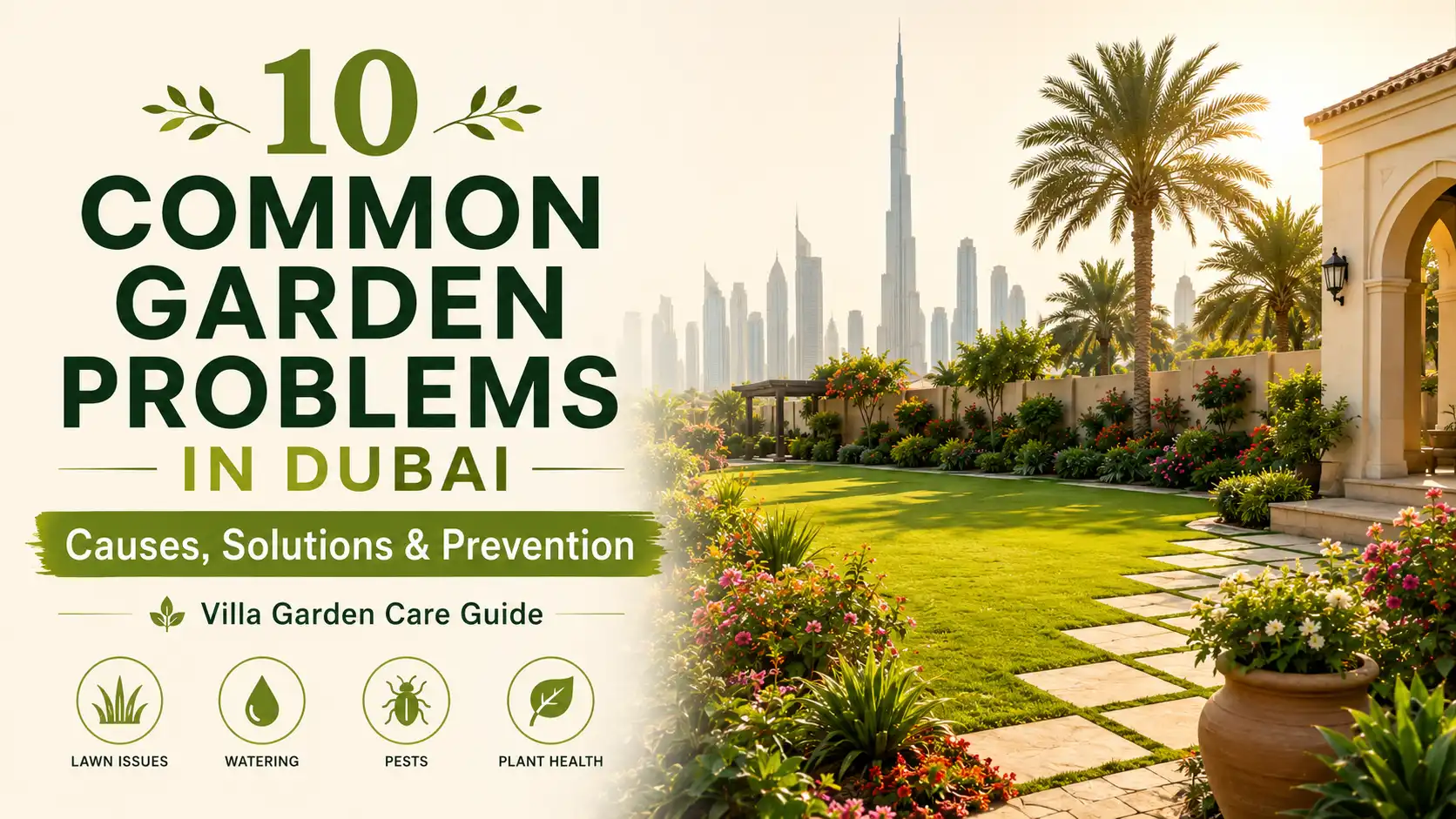
Even well-maintained Dubai villa gardens develop problems. Some are the result of climate extremes. Some are irrigation failures. Some are pest or disease issues. And some are caused by well-intentioned but incorrect maintenance practices.
The good news is that almost every common Dubai garden problem has a clear cause, and a straightforward solution. The key is identifying the problem correctly before applying the wrong treatment and making things worse.
Here are the 10 most common garden problems we encounter at Flowers Yard Landscaping across Dubai villa communities, with the cause, the solution, and how to prevent it happening again.
Top 10 Garden Problems in Dubai
Problem 1: Yellow or Brown Lawn Patches
Symptoms: Irregular or consistent yellow or brown patches appearing in natural grass lawn. May be uniform across the whole lawn or concentrated in specific areas.
Possible causes:
1- Irrigation failure — The most common cause. A blocked sprinkler head, failed irrigation zone, or timer programming error leaves sections of lawn without water. In Dubai summer, grass begins dying within 48–72 hours without irrigation.
2- Overwatering — Counterintuitively, overwatering causes yellowing through root rot and oxygen deprivation. Signs include soil that stays wet for 24+ hours between irrigation cycles and a sour smell from the soil.
3- Salt accumulation — Dubai’s high-mineral irrigation water deposits salt in the root zone over time. Salt toxicity prevents water absorption even when irrigation is running correctly, causing progressive yellowing.
4- Lawn disease (Brown patch fungus) — Circular brown patches with a slightly darker ring around the edge. More common in humid summer conditions or where irrigation runs late in the evening.
5- Grubs or pest damage — Army worms and sod webworm caterpillars eat grass roots and blades, causing irregular dead patches. Pull back dead grass — if it lifts easily like a loose rug, grub damage is likely.
Solution: Test each irrigation zone manually to confirm coverage. Flush the soil deeply (double irrigation duration) to push salt below root depth. Treat fungal disease with appropriate fungicide. Treat pest damage with targeted insecticide. Replace dead turf sections in October.
Prevention: Quarterly irrigation system checks, monthly soil flush irrigation cycle, morning-only irrigation timing (avoid evening watering), regular pest monitoring.
Problem 2: Plants Wilting Despite Watering
Symptoms: Plants look visibly stressed, drooping, or wilting even though the irrigation system is running or manual watering is occurring.
Possible causes:
1- Root rot from overwatering — When roots suffocate from excess moisture, they can no longer absorb water even when it’s available. The plant wilts because its root system is damaged, not because it’s dry.
2- Salt accumulation in root zone — As described above, salt buildup prevents roots from absorbing water effectively.
3- Incorrect irrigation placement — Drip emitters may be positioned too far from the plant’s root zone, watering the soil around the plant rather than beneath it.
4- Transplant shock — Newly planted specimens often wilt for 1–4 weeks while root systems establish. This is normal if irrigation is correct.
5- Root competition — Plants positioned too close to large trees or aggressive shrubs may have their root systems outcompeted for both water and nutrients.
Solution: Check irrigation emitter placement and flow rate. Test soil drainage by digging 30cm down — waterlogged soil indicates drainage or overwatering issues. Perform a deep salt flush. Adjust plant spacing if root competition is identified.
Prevention: Correct plant spacing at installation, proper drip emitter placement, well-structured irrigation schedule with appropriate rest periods between cycles.
Problem 3: Yellowing Leaves on Shrubs and Plants
Symptoms: Leaves turning yellow, often starting at older (lower) leaves first, or affecting new growth first depending on the cause.
Possible causes:
1- Nutrient deficiency (most common) — Yellow leaves with green veins indicate iron or magnesium deficiency, extremely common in Dubai due to alkaline soil that locks up micronutrients. Uniform yellowing of older leaves indicates nitrogen deficiency.
2- Overwatering — Yellowing from root rot starts with lower leaves and progresses upward.
3- Salt toxicity — Yellowing with brown leaf tips and edges, particularly on new growth.
4- Spider mite infestation — Fine stippling (tiny dots) across leaf surface, sometimes with fine webbing on undersides. Leaves turn pale green, then yellow.
Solution: For nutrient deficiency — apply chelated iron and magnesium foliar spray, plus a soil acidifier to improve nutrient uptake. For salt — deep flush irrigation. For spider mites — spray leaf undersides with neem oil or insecticidal soap weekly for 3 weeks.
Prevention: Regular feeding programme with micronutrient-inclusive fertiliser. Avoid excessive irrigation. Weekly pest monitoring, especially on plant undersides.
Problem 4: White Powdery Coating on Leaves
Symptoms: White, powdery or chalky coating on leaf surfaces, often starting on young growth. Affected leaves may curl, distort, or drop.
Cause: Powdery mildew — a fungal disease that thrives in conditions of high temperature combined with high humidity and poor air circulation. More common during Dubai’s summer transition months (May and September).
Solution: Remove severely affected leaves immediately. Apply a sulphur-based or potassium bicarbonate fungicide spray, coating both upper and lower leaf surfaces. Improve air circulation by thinning dense planting. Avoid overhead watering, water at root level only.
Prevention: Space plants to allow air circulation. Water in the morning only. Apply preventative fungicide spray to susceptible plants (roses, cucurbits) at the start of the humid season.
Problem 5: Mealy Bugs on Plants
Symptoms: White, fluffy, cotton-like deposits in leaf joints, on stems, and around new growth. Affected plants look unhealthy and may have sticky residue (honeydew) on leaves.
Cause: Mealybugs are soft-bodied insects that feed on plant sap. They reproduce rapidly in Dubai’s warm climate and can devastate plants — particularly succulents, ornamental shrubs, and indoor plants moved outdoors — within weeks if untreated.
Solution: Remove visible mealybugs manually using a cotton swab dipped in rubbing alcohol. Spray all affected surfaces with a neem oil solution (1 tablespoon neem oil + 1 litre water + a few drops of dish soap) weekly for 4 weeks. For severe infestations, use a systemic insecticide applied to the root zone.
Prevention: Inspect all new plants before introducing them to the garden. Check plants weekly for early signs. Avoid over-fertilising with nitrogen, which produces the soft, sappy growth that mealybugs prefer.
Problem 6: Holes or Chewed Edges on Leaves
Symptoms: Irregular holes in leaves, chewed edges, or entire leaves stripped from stems. Often noticed in the morning after overnight feeding activity.
Cause: Caterpillars (most commonly) or grasshoppers. In Dubai, various caterpillar species are active year-round but peak in cooler months. Heavy caterpillar infestations can defoliate plants within days.
Solution: Inspect plants in the evening when caterpillars are active. Hand-pick visible caterpillars. Apply a Bacillus thuringiensis (Bt) spray, a biological insecticide that kills caterpillars without harming other insects or animals. For severe infestations, a pyrethroid insecticide provides faster control.
Prevention: Regular evening inspections during growing season. Encourage beneficial insects (birds, wasps) by providing habitat. Avoid broad-spectrum insecticides that kill beneficial predators.
Problem 7: No Flowers on Established Plants
Symptoms: Bougainvillea, adenium, jasmine, or other flowering plants produce lush foliage but few or no flowers.
Cause:
1- Overwatering — Bougainvillea in particular produces maximum flower when slightly water-stressed. Consistent heavy irrigation encourages leaf growth at the expense of flowering.
2- Excessive nitrogen — High-nitrogen fertilisation promotes vegetative growth (leaves and stems) rather than reproductive growth (flowers). This is the most common cause of non-flowering in established bougainvillea.
3- Insufficient sunlight — Most flowering plants in Dubai need 6+ hours of direct sun to flower well. Shaded plants produce fewer blooms.
4- Incorrect pruning timing — Pruning immediately before the flowering season removes the buds that would become flowers.
Solution: For bougainvillea — reduce irrigation significantly and switch to a low-nitrogen, high-phosphorus fertiliser. For most flowering plants, ensure adequate sun exposure. Review pruning timing, prune immediately after flowering, not before.
Prevention: Use balanced or phosphorus-heavy fertiliser for flowering plants. Position flowering plants in full sun. Avoid over-irrigating established flowering shrubs.
Problem 8: Garden Soil Becoming Waterlogged
Symptoms: Water pools on the surface after irrigation. Soil feels soggy and compressed. Plants show root rot symptoms (yellowing, wilting) despite apparent adequate water supply.
Cause: Poor soil drainage — common in Dubai properties where construction fill soil (heavily compacted sand/gravel) prevents water from percolating. Compacted surface soil also prevents absorption.
Solution: Aerate compacted soil using a core aerator or garden fork. Improve soil structure by incorporating organic matter (compost or perlite) to improve drainage. For persistent waterlogging, install French drains to redirect excess water. Raise planting beds to improve natural drainage.
Prevention: Incorporate organic matter at planting stage. Avoid over-irrigation. Aerate lawn areas annually.
Problem 9: Rapid Weed Growth in Garden Beds
Symptoms: Weeds — particularly summer annual weeds like spurge, goathead, and sedge — appearing rapidly in garden beds, particularly after irrigation begins.
Cause: Dubai’s soil contains viable weed seeds, and the combination of consistent irrigation and warm soil creates ideal germination conditions. Weeds are opportunists — bare soil with moisture will grow them.
Solution: Remove weeds by hand before they set seed. Apply a thick layer of organic mulch (5–8cm) to suppress germination. Use a pre-emergent herbicide in April to reduce summer weed pressure. Spot-treat persistent weeds with a targeted selective herbicide.
Prevention: Maintain a thick mulch layer year-round. Apply pre-emergent treatment annually. Plant densely to reduce bare soil — bare soil grows weeds.
Problem 10: Fruit Flies and Insects Around Plants
Symptoms: Large numbers of small flies around plants — particularly fruiting plants, composting areas, or plants with sweet-smelling flowers.
Cause: Fruit flies are attracted by decaying organic matter, overripe fruit, and certain flowers. In Dubai’s heat, organic matter decomposes rapidly, creating breeding habitats quickly.
Solution: Remove fallen fruit, dead plant material, and decaying organic matter promptly. Avoid composting in open bins during summer. Use yellow sticky traps near affected plants to reduce adult population.
Prevention: Maintain a clean garden — remove all fallen organic material after every maintenance visit. Harvest fruit promptly. Use enclosed composting systems if composting in the garden.
Frequently Asked Questions
1- Why are my grass patches turning yellow in Dubai?
The most common reason is an irrigation failure, a blocked sprinkler head or failed zone leaving that section of lawn without water. In Dubai summer, grass begins dying within 48 to 72 hours without irrigation, so yellow patches can appear very quickly. Other causes include salt accumulation from Dubai’s mineral-heavy water, overwatering causing root rot, or brown patch fungus from evening irrigation. Run each irrigation zone manually to check coverage before assuming the problem is disease or pests.
2- Why is my plant wilting even though I’m watering it?
This usually means the roots can’t absorb the water, not that there isn’t enough of it. The two most common causes in Dubai gardens are root rot from overwatering, where the roots suffocate in waterlogged soil, and salt accumulation in the root zone, which prevents water uptake even when the irrigation is running correctly. Check whether your soil stays wet for longer than 24 hours after irrigation. If it does, overwatering is likely the problem.
3- Why are my plant leaves turning yellow in Dubai?
Yellow leaves with green veins usually indicate iron or magnesium deficiency, very common in Dubai because the naturally alkaline soil locks up these micronutrients and prevents plants from absorbing them. Uniform yellowing starting on older lower leaves points to nitrogen deficiency. Yellowing with brown leaf tips, particularly on new growth, is often salt toxicity. Applying a chelated iron foliar spray and a soil acidifier resolves most nutrient-related yellowing within a few weeks.
4- What is the white powder on my plant leaves?
That is powdery mildew, a fungal disease. It appears as a chalky white coating on leaf surfaces, usually starting on new growth. It thrives in Dubai’s summer transition months, May and September, when temperatures are high and humidity rises. Remove affected leaves immediately, apply a sulphur-based fungicide spray to both upper and lower leaf surfaces, and switch to morning-only root-level watering. Avoid overhead watering entirely, as wet foliage overnight encourages the fungus to spread.
5- How do I get rid of mealybugs on my plants in Dubai?
Start by removing visible mealybugs manually using a cotton swab dipped in rubbing alcohol. Then spray all affected surfaces — including stems and leaf joints — with a neem oil solution made from one tablespoon of neem oil per litre of water with a few drops of dish soap. Repeat this weekly for four weeks. For a severe infestation, a systemic insecticide applied to the root zone works through the plant’s tissue and reaches insects you can’t see. Check new plants carefully before bringing them into your garden, as mealybugs spread easily.
6- Why is my bougainvillea not flowering?
The most common reason is overwatering. Bougainvillea actually produces more flowers when it’s slightly water-stressed, consistent heavy irrigation pushes the plant into producing leaves rather than blooms. The second common cause is too much nitrogen fertiliser, which also encourages vegetative growth at the expense of flowering. Reduce your irrigation frequency significantly, switch to a low-nitrogen high-phosphorus fertiliser, and make sure the plant is getting at least six hours of direct sun. You should see flowering improve within four to six weeks.
7- Why does my garden soil get waterlogged in Dubai?
Most Dubai villa gardens were built on construction fill soil — heavily compacted sand and gravel that drains poorly. This prevents irrigation water from percolating downward, causing it to pool at the surface and around roots. Aerating the soil, incorporating compost or perlite to improve soil structure, and raising planting beds all help. For persistent waterlogging in larger areas, installing French drains to redirect excess water is the most reliable long-term solution.
8- What weeds are common in Dubai gardens, and how do I stop them?
The most common summer weeds in Dubai gardens are spurge, goathead, and sedge. They germinate rapidly once irrigation begins because Dubai’s soil contains viable weed seeds and the warm, consistently moist conditions are ideal for germination. The most effective prevention is a thick layer of organic mulch — 5 to 8cm — which suppresses germination by blocking light. Applying a pre-emergent herbicide in April before the hot season begins significantly reduces summer weed pressure. Dense planting also helps, as bare soil is where weeds take hold.
9- Why do I have so many flies around my garden plants?
Fruit flies are attracted to decaying organic matter, fallen fruit, dead plant material, and decomposing garden waste. Dubai’s heat accelerates decomposition significantly, so organic matter left on the ground creates breeding habitat very quickly. Remove fallen fruit and dead plant material promptly after every maintenance visit. Yellow sticky traps placed near affected plants help reduce the adult population. If you compost, switch to an enclosed composting system during summer rather than open bins.
10- When should I call a professional about my Dubai garden problems?
If you have treated a problem and it keeps coming back, or if you’re seeing multiple problems appearing at the same time across your garden, it usually points to a systemic issue, with your irrigation design, soil quality, or plant selection, rather than an isolated pest or disease. Treating symptoms repeatedly without identifying the root cause costs more time and money in the long run. Our garden maintenance team diagnoses and treats problems as part of every maintenance visit. Get in touch via WhatsApp on +971 55 678 6066 if you’d like us to take a look.
Get Professional Help with Dubai Garden Problems
Persistent garden problems are often a sign of a systemic issue — irrigation design, soil quality, or plant selection, rather than a simple pest or disease that can be treated once and forgotten. Addressing the root cause is always more effective than repeated treatment of symptoms. At Flowers Yard Landscaping, our garden maintenance team identifies and resolves garden problems across Dubai villa communities, with expert diagnosis and treatment built into every maintenance visit.